That satisfying feeling when you stretch first thing in the morning or after sitting for hours at your desk? There’s actual science behind it.

Stretching activates your parasympathetic nervous system, increases blood flow to your muscles, and releases built-up tension. The result is that wave of relief and relaxation that makes you want to stretch even more.
Let’s break down exactly what’s happening in your body when you stretch and why it feels so good.
 Lose weight
 Gain muscles
 Eat healthy
 Explore new cuisines

 Kevin H.
 Available on the App Store
Your nervous system shifts into relaxation mode
When you stretch, especially at low to moderate intensity, your body activates the parasympathetic nervous system—often called the “rest and digest” system.1
This shift triggers several calming responses:
- Your heart rate slows down
- Breathing becomes deeper and more rhythmic
- Stress hormones like cortisol decrease
- Your muscles begin to relax
Research shows that stretching intensity matters here. Low-intensity stretching is associated with parasympathetic activation, while high-intensity stretching activates your sympathetic (fight-or-flight) system instead.1 This is why gentle, controlled stretches feel more relaxing than aggressive ones.
Yoga-based stretching has been shown to significantly enhance parasympathetic nerve activity while reducing stress hormones like cortisol.2 The combination of slow movements and deep breathing amplifies this calming effect.
Summary: Stretching activates your parasympathetic nervous system, shifting your body from stress mode into relaxation mode.
Blood flow increases to your muscles
When you stretch a muscle, you’re also affecting the blood vessels running through it. The mechanical action of stretching causes blood vessels to dilate, increasing blood flow to the stretched area.3
This happens through several mechanisms:
- Mechanical deformation: Stretching physically expands the vascular bed
- Vasodilation: Blood vessels widen in response to stretch
- Post-stretch hyperemia: After you release a stretch, blood flow temporarily increases even more4
Studies have found that the minimum duration of stretching needed to sustain increased muscle blood volume is about 2 minutes.4 Longer stretches produce even greater increases in both blood volume and oxygenation after you release.
This increased blood flow delivers more oxygen and nutrients to your muscles while flushing out metabolic waste products. It’s one reason why stretching feels especially good after prolonged sitting—you’re essentially jumpstarting circulation in tissues that have been relatively stagnant.
Regular stretching also produces long-term vascular benefits. Research on aged skeletal muscle shows that daily passive stretching enhances endothelial function and even promotes the growth of new capillaries.3
Summary: Stretching increases blood flow to your muscles both during and after the stretch, delivering oxygen and removing waste products.

Muscle tension gets released
Your muscles have built-in sensors called proprioceptors that constantly monitor muscle length, tension, and movement. Two key types are muscle spindles and Golgi tendon organs.
Muscle spindles detect when a muscle is being stretched and how fast. They’re responsible for that initial resistance you feel when you start a stretch.5
Golgi tendon organs monitor muscle tension. When tension gets too high, they trigger a protective relaxation response to prevent injury.
During sustained stretching, these sensors gradually adapt. The initial resistance you feel decreases as your nervous system accepts the new muscle length as safe. This process, called stretch tolerance, explains why you can ease deeper into a stretch over time.
The release of this tension is satisfying on multiple levels. Physically, the muscle relaxes. Neurologically, the constant signals of tightness that your brain has been processing fade. Many people describe this as a feeling of “letting go.”
If you’ve ever felt immediate relief from stretching a tight muscle, you’ve experienced this phenomenon. The muscle wasn’t necessarily shortened—your nervous system was simply holding it at a higher baseline tension than necessary.
Summary: Stretching resets the tension sensors in your muscles, allowing them to relax and reducing the tightness signals sent to your brain.
Suggested read: Stretch Therapy: Benefits, Risks, and How It Works
The mood boost is real
Beyond the physical sensations, stretching can genuinely improve your mood. Part of this comes from the parasympathetic activation we discussed—stress reduction naturally improves how you feel.
But there’s also a sensory pleasure component. The physical sensation of a good stretch activates reward circuits in your brain. It’s similar to why massage feels good: the combination of pressure, release, and improved circulation creates a positive sensory experience.
While the popular claim that stretching “releases endorphins” isn’t strongly supported by research (endorphin release typically requires more intense physical activity), the mood benefits of stretching are real through other mechanisms:
- Reduced cortisol and stress hormones2
- Activation of relaxation pathways
- Improved body awareness and mindful presence
- Relief from discomfort caused by muscle tightness
For many people, the psychological benefits of stretching are just as valuable as the physical ones. Taking a few moments to stretch serves as a mental break, a moment of body awareness, and an opportunity to release accumulated tension.
Summary: Stretching improves mood through stress reduction, activation of relaxation pathways, and the satisfying sensation of releasing muscle tension.
Suggested read: Active Stretching: Benefits, Exercises, and How to Do It
Why stretching feels especially good at certain times
You’ve probably noticed that stretching feels particularly satisfying in specific situations:
In the morning: After hours of relative immobility during sleep, your muscles and joints are at their stiffest. That morning stretch (called pandiculation—the instinctive stretching that occurs when waking) helps restore blood flow and mobility.
After sitting for hours: Prolonged sitting leads to reduced blood flow, shortened hip flexors, and increased muscle tension. Stretching reverses all of these, creating an especially pronounced sense of relief.
During exercise warmups: When your muscles are cold, stretching combined with movement increases blood flow and prepares your body for activity.
Before bed: Gentle stretching before sleep activates the parasympathetic nervous system, helping your body transition into rest mode.
The intensity of the satisfying feeling often correlates with how much tension you’ve accumulated. The tighter and more restricted you feel beforehand, the greater the relief when you stretch.
How to maximize the good feelings from stretching
If you want to get the most satisfaction (and benefit) from your stretches:
Hold stretches for at least 2 minutes. Research shows this is the minimum duration to sustain increased blood flow after you release.4
Keep intensity moderate. Stretching to mild discomfort—not pain—keeps your nervous system in relaxation mode rather than stress mode.1
Breathe deeply. Deep, slow breaths amplify parasympathetic activation and help your muscles relax more fully.
Stretch consistently. Regular stretching produces cumulative benefits for blood flow, muscle tension, and flexibility.3
Focus on tight areas. The muscles that feel most restricted will typically provide the most satisfaction when stretched.
Frequently Asked Questions
Why does stretching feel so good?
Stretching feels good because it activates your parasympathetic nervous system, increases blood flow to your muscles, and releases built-up tension. These combined effects create a wave of relaxation and satisfaction.
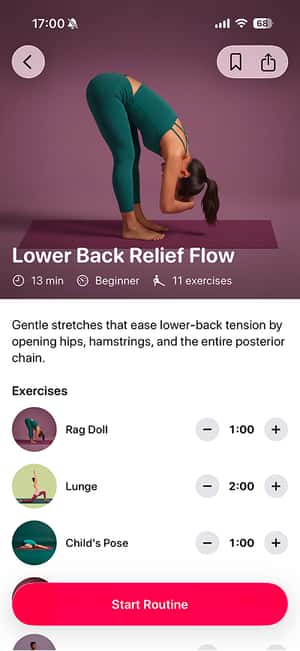
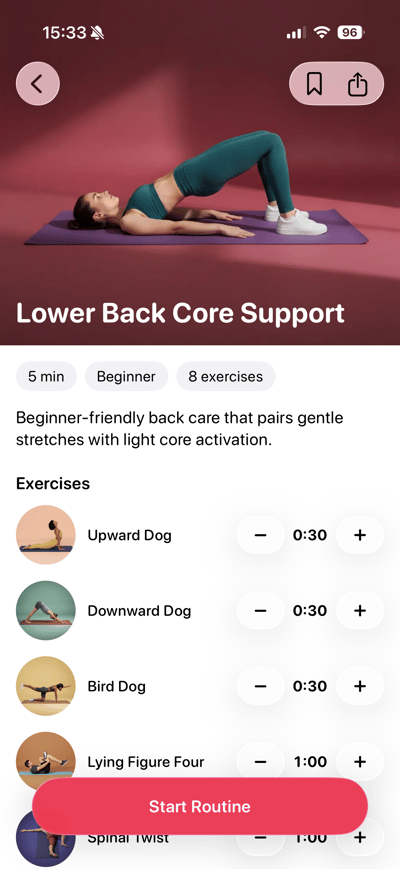
For maximum benefit, hold stretches for at least 2 minutes and keep the intensity moderate. The Stretching Workout app provides timed routines with voice guidance that help you hold stretches long enough to get the full relaxation response.
Suggested read: Best Stretching App (We Tested 9 Options)
Why does stretching in the morning feel good?
Morning stretching feels especially good because your muscles are at their stiffest after hours of sleep immobility. The sudden increase in blood flow and release of overnight tension creates a pronounced sense of relief and alertness.
This is your body performing pandiculation—an instinctive reset of the muscular system. A morning stretching routine can turn this natural reflex into a daily habit.
Why does stretching hurt but feel good?
The mild discomfort during stretching comes from muscle spindles detecting lengthening, while the pleasure comes from tension release and increased blood flow. Your brain processes both signals simultaneously, creating that satisfying “hurts so good” sensation.
The key is staying in the mild discomfort zone. Sharp pain means you’ve gone too far—back off and let your nervous system adapt gradually.
Why does stretching sore muscles feel good?
Stretching sore muscles feels good because it increases blood flow to the affected area, delivering oxygen and nutrients while flushing out metabolic waste. It also temporarily overrides the tension signals your nervous system has been sending from the sore muscles.
Gentle stretching after workouts is one of the best ways to manage delayed onset muscle soreness (DOMS).
Does stretching release endorphins?
While the popular claim that stretching releases endorphins isn’t strongly supported by research, stretching does improve mood through other mechanisms—reducing cortisol, activating relaxation pathways, and providing sensory pleasure from tension release.
Regular stretching habits deliver cumulative mood benefits. Apps like Stretching Workout help you build consistency with guided daily routines.
Summary
Stretching feels good because it triggers multiple beneficial responses in your body simultaneously. Your parasympathetic nervous system activates, shifting you into relaxation mode. Blood flow increases, delivering oxygen and nutrients while flushing out waste. Muscle tension releases as your proprioceptors adapt to new lengths.
The combination of these effects creates that wave of satisfaction and relief you feel during a good stretch. It’s not just in your head—it’s a genuine physiological response that benefits your body and mind.
If you want to build a consistent stretching habit, the Stretching Workout app offers guided routines with timers and voice cues to help you hold stretches long enough to get the full benefits. For a complete guide to getting started, check out The Complete Beginner’s Guide to Stretching.
Imagawa N, Mizuno Y, Nakata I, et al. The Impact of Stretching Intensities on Neural and Autonomic Responses: Implications for Relaxation. Sensors (Basel). 2023;23(15):6890. PubMed ↩︎ ↩︎ ↩︎
Eda N, Ito H, Akama T. Beneficial Effects of Yoga Stretching on Salivary Stress Hormones and Parasympathetic Nerve Activity. J Sports Sci Med. 2020;19(4):695-702. PubMed ↩︎ ↩︎
Hotta K, Behnke BJ, Arjmandi B, et al. Daily muscle stretching enhances blood flow, endothelial function, capillarity, vascular volume and connectivity in aged skeletal muscle. J Physiol. 2018;596(10):1903-1917. PubMed ↩︎ ↩︎ ↩︎
Matsuo H, Kubota M, Shimada S, et al. The Effect of Static Stretching Duration on Muscle Blood Volume and Oxygenation. J Strength Cond Res. 2022;36(2):379-385. PubMed ↩︎ ↩︎ ↩︎
Banks RW, Ellaway PH, Prochazka A, Proske U. Secondary endings of muscle spindles: Structure, reflex action, role in motor control and proprioception. Exp Physiol. 2021;106(12):2339-2366. PubMed ↩︎
 Sarah M.
 Linda P.
 Maya T.
 Marcus J.
 Emma R.
 Amanda K.
 Chris B.
 David L.
 James W.
 Jennifer S.
 Kevin H.
 Lisa C.
 App Store ★★★★★