Vitamin B6 for PMS has more trial history than almost any other supplement — it’s been studied for premenstrual symptoms since the 1970s. The picture has evolved: early enthusiasm gave way to skepticism, and more recent systematic reviews have settled into a clearer middle position. B6 does help, particularly for the psychological symptoms (irritability, mood, anxiety), and it works even better in combination with magnesium or calcium.
This article covers what doses actually have evidence, the safety ceiling (real but often misunderstood), and how to use B6 sensibly for PMS.
Quick answer
Dose: 50–100 mg of vitamin B6 (pyridoxine HCl or P5P) per day. When: Daily through the cycle, or specifically through the luteal phase if you prefer. What it helps most: Mood, irritability, anxiety. Some effect on physical symptoms too. Best stack: B6 + magnesium (200–400 mg), or B6 + calcium (1,200 mg). Safety ceiling: Stay below 200 mg/day long-term — higher doses can cause peripheral neuropathy.
Choose your goal and get a meal plan that considers your hormonal health.
Powered by DietGenie Eat healthy
 Lose weight
 Gain muscles
 Explore new cuisines
What the research shows
A 2025 systematic review of nutritional interventions for the psychological symptoms of PMS — looking at 31 RCTs in 3,254 participants — concluded that vitamin B6 had consistent positive effects on PMS mood symptoms, alongside calcium and zinc.1 These three nutrients were the only ones with consistent evidence across the trials reviewed.
A 2017 Joanna Briggs Institute systematic review of B vitamins for premenstrual symptoms specifically singled out B6 combined with magnesium as effective for reducing premenstrual anxiety.2 B6 alone helped in older women.
The older Wyatt et al. 1999 BMJ review of B6 for PMS — which originally established the standard reference range — found benefit at doses up to 100 mg/day. The dose-response above 100 mg got murky, and the safety profile worsened, which is where the modern dosing recommendations come from.
So the picture isn’t “B6 cures PMS” — it’s “B6 reliably helps PMS-related mood symptoms in moderate doses, particularly when stacked with magnesium or calcium.”
How B6 actually works
Vitamin B6 (in its active form, pyridoxal-5-phosphate or P5P) is a coenzyme in over 100 biochemical reactions. The ones that matter most for PMS:
- Neurotransmitter synthesis: B6 is required to make serotonin (from tryptophan), dopamine, GABA, and norepinephrine. Serotonin pathways are central to PMS-related mood swings — this is one of the leading hypotheses for why B6 helps.
- Estrogen metabolism: B6 supports phase II liver detoxification, including clearance of estrogen metabolites. This is the basis for the older theory that B6 helps PMS by reducing relative estrogen excess in the luteal phase.
- Homocysteine regulation: Together with folate and B12, B6 keeps homocysteine in check — relevant for cardiovascular and cognitive health more than for PMS specifically, but a useful side effect.
If you want the broader picture, health benefits of vitamin B6 covers what it does across the body, and B6 deficiency symptoms walks through signs your baseline B6 might already be low.
Dosing for PMS: the practical range
The sweet spot: 50–100 mg/day
This is the range with the best evidence-to-risk ratio. Most trials that found benefit used doses in this range.
- 50 mg/day is a good starting dose for mild-to-moderate PMS
- 100 mg/day for more pronounced mood symptoms
- Above 100 mg the marginal benefit drops and side-effect risk rises
Daily vs. luteal-only dosing
Both have been studied. The evidence doesn’t strongly favor one over the other — B6 doesn’t accumulate in tissues the way fat-soluble vitamins do, so the case for “luteal-only” dosing is more about minimizing total intake than about pharmacology.
A reasonable middle ground:
Suggested read: PCOS Supplements: Evidence-Based Guide to What Works
- Daily if you tend to forget supplements and want a simple routine
- Luteal-only (from ovulation, around day 14, through day 1 of your period) if you want to minimize total exposure or stack it with other luteal-only supplements
Form: pyridoxine HCl vs. P5P
- Pyridoxine HCl is the most studied form and the one used in nearly every PMS trial
- P5P (pyridoxal-5-phosphate) is the active form. It bypasses the liver conversion step, which matters if you have a genetic variant or liver issue that impairs activation
- For most people, plain pyridoxine HCl is fine
If you’ve tried pyridoxine HCl at 50–100 mg and felt nothing, switching to 25–50 mg of P5P is a reasonable next experiment.
The safety ceiling: why you don’t go above 200 mg
This is the most important section of this article. Chronic high-dose B6 — typically above 200 mg/day for months to years — can cause sensory peripheral neuropathy: tingling, numbness, burning, or weakness in the hands and feet.
Key facts:
- Reversible if caught early — symptoms usually resolve over months after stopping
- Permanent in some cases of very high chronic dosing (>1,000 mg/day for years)
- Has happened at doses as low as 200–500 mg/day in long-term users
- The EU’s tolerable upper intake level is 25 mg/day; the U.S. UL is 100 mg/day. Both are conservative — short-term doses up to 100 mg/day in trials have been safe
- The risk is dose × duration. Brief use at 50–100 mg/day is well tolerated
Practical safety rules:
- Stay at or below 100 mg/day for chronic use
- Don’t exceed 200 mg/day at all
- If you feel any tingling or numbness in your hands or feet, stop and see a doctor
- Be aware that some B-complex products or “PMS support” formulas already contain B6 — add it up
Stacking B6 with other PMS interventions
B6 plays well with the other evidence-backed PMS supplements. The combinations with the strongest data:
Suggested read: Creatine and Cognition: Memory, Brain, Honest Evidence
B6 + magnesium
A 2017 systematic review specifically found that B6 + magnesium combinations reduce premenstrual anxiety, while either alone had less effect.2 A typical stack:
- B6: 50–100 mg/day
- Magnesium: 200–400 mg/day (use magnesium glycinate for best tolerability)
Take them in the evening — magnesium also supports sleep.
B6 + calcium
A 2016 RCT compared calcium + B6 to B6 alone and found significantly better symptom reduction with the combination.3 A reasonable stack:
- B6: 50–100 mg/day
- Calcium: 1,200 mg/day, split into two doses (see calcium for PMS)
B6 + magnesium + calcium
There’s no head-to-head trial of all three together, but stacking all three is reasonable given the independent evidence for each and the lack of interactions. This is essentially the “supplement floor” for someone serious about PMS.
For broader context on which natural PMS interventions actually have evidence, see natural PMS remedies. If your symptoms are severe enough to affect work, sleep, or relationships, the question may be PMDD rather than PMS.
Food sources of B6
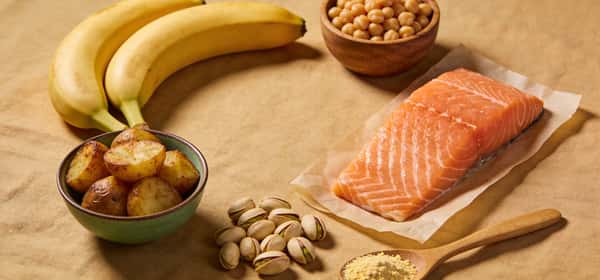
You can also get a meaningful B6 baseline from food, though hitting 50–100 mg from diet alone is impractical. High-B6 foods:
| Food | B6 per serving |
|---|---|
| Chickpeas, 1 cup cooked | 1.1 mg |
| Beef liver, 3 oz | 0.9 mg |
| Yellowfin tuna, 3 oz | 0.9 mg |
| Salmon, 3 oz | 0.6 mg |
| Chicken breast, 3 oz | 0.5 mg |
| Potato, 1 medium baked | 0.4 mg |
| Banana, 1 medium | 0.4 mg |
Reaching the standard 1.3–1.5 mg/day RDA from food is easy. Reaching 50 mg is not — that’s why supplementation is the realistic path for PMS dosing.
When B6 isn’t enough
B6 reduces PMS symptoms in a meaningful subset of women, but it’s not a 100% responder situation. If you’ve tried 50–100 mg/day for 2–3 cycles, alone or in combination with calcium and magnesium, and you’re still struggling:
- Consider whether you may be dealing with PMDD rather than PMS — see what is PMDD
- Try standardized chasteberry (Vitex agnus-castus) — see vitex (chasteberry)
- Add aerobic exercise 3–5 days a week
- Talk to a doctor about whether SSRI luteal-phase dosing or hormonal contraception is appropriate
Bottom line
Vitamin B6 for PMS is one of the few natural interventions with multi-decade trial evidence behind it. Use 50–100 mg/day of pyridoxine HCl, stay below 200 mg long-term, and stack with magnesium or calcium for the best results. Give it 2–3 cycles before judging effect. If hands or feet start tingling, stop immediately and see a doctor — that’s the one side effect to take seriously.
Robinson J, Ferreira A, Iacovou M, Kellow NJ. Effect of nutritional interventions on the psychological symptoms of premenstrual syndrome in women of reproductive age: a systematic review of randomized controlled trials. Nutrition Reviews. 2025;83(2):280-306. PubMed | DOI ↩︎
McCabe D, Lisy K, Lockwood C, Colbeck M. The impact of essential fatty acid, B vitamins, vitamin C, magnesium and zinc supplementation on stress levels in women: a systematic review. JBI Database of Systematic Reviews and Implementation Reports. 2017;15(2):402-453. PubMed | DOI ↩︎ ↩︎
Masoumi SZ, Ataollahi M, Oshvandi K. Effect of Combined Use of Calcium and Vitamin B6 on Premenstrual Syndrome Symptoms: a Randomized Clinical Trial. Journal of Caring Sciences. 2016;5(1):67-73. PubMed | DOI ↩︎