You’ve probably heard that turkey makes you sleepy because it’s loaded with tryptophan, the building block of serotonin. It’s a tidy story, and it’s mostly wrong. Tryptophan foods do supply the raw material your body needs, but the path from your plate to brain serotonin is full of competition and bottlenecks. Eating more tryptophan does not reliably raise serotonin — and the foods that help most aren’t always the ones with the most tryptophan. Let’s sort out what’s true.
Quick answer
- Tryptophan is an essential amino acid — you get it from food, and it’s the starting point for serotonin
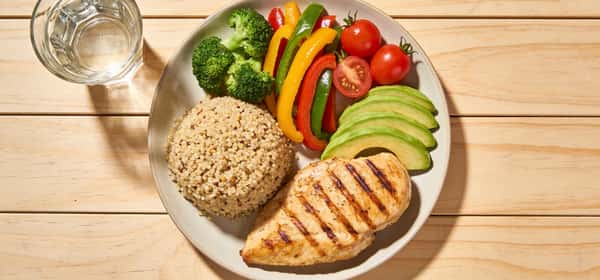
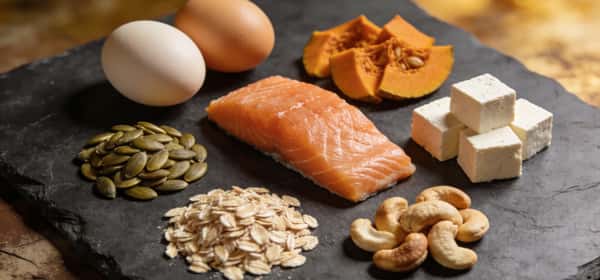
- Top sources: turkey, chicken, eggs, cheese, fish, tofu, nuts, seeds, oats
- The catch: protein-rich meals also flood your blood with amino acids that compete with tryptophan for entry into the brain
- Carbs help — they clear the competitors out of the way, giving tryptophan a clearer path
- No single food spikes serotonin — diet supports the system slowly, not on demand
Best tryptophan foods
Tryptophan shows up across animal and plant proteins. Here are reliable sources by category:
| Food | Why it’s notable |
|---|---|
| Turkey, chicken | Solid tryptophan content (the famous one) |
| Eggs | Complete protein, tryptophan in the white and yolk |
| Cheese, dairy | Concentrated source per serving |
| Salmon, tuna | Tryptophan plus omega-3s |
| Tofu, soy, tempeh | Best plant-based complete protein source |
| Pumpkin seeds, sesame seeds | Among the densest plant sources |
| Nuts (cashews, almonds) | Convenient, also magnesium |
| Oats | Tryptophan plus the carbs that help it work |
You don’t have to chase these aggressively. Tryptophan is the rarest essential amino acid in the diet, but any reasonably balanced eating pattern covers your needs easily. Deficiency is uncommon outside of severe undereating or restrictive disorders.1
Choose your goal and get a meal plan that's good for body and mind.
Powered by DietGenie Eat healthy
 Lose weight
 Gain muscles
 Explore new cuisines
Why food tryptophan isn’t instant serotonin
Here’s the part that breaks the myth. Tryptophan can’t cross the blood-brain barrier on its own. It rides a shared transporter — the same one used by several other large neutral amino acids (LNAAs) like leucine, isoleucine, valine, tyrosine, and phenylalanine. They all compete for the same doors into the brain.
Protein-rich foods, including high-tryptophan ones, are even richer in those competing amino acids. So when you eat a turkey breast, you raise blood tryptophan and you raise its competitors even more. The ratio of tryptophan to its rivals can actually drop, meaning less tryptophan gets into the brain, not more.2 That’s the irony: the highest-tryptophan meals can be the worst at delivering tryptophan to the brain.
That’s also why the sleepy-turkey idea falls apart. The post-meal drowsiness after a big holiday dinner is about portion size, carbohydrates, and timing — not a tryptophan overdose.
The carbohydrate twist
So how does tryptophan ever win the competition? Carbohydrates.
When you eat carbs, your body releases insulin. Insulin pulls most of the competing amino acids out of the bloodstream and into muscle tissue — but it leaves tryptophan relatively untouched, because much of it is bound to a blood protein and shielded from that pull. The result: the tryptophan-to-competitor ratio rises, and more tryptophan reaches the brain.
A controlled feeding trial showed this directly. A high-carbohydrate, lower-protein breakfast raised the blood tryptophan-to-LNAA ratio and produced measurable changes in brain activity, while a high-protein breakfast did not.2 This is the mechanism behind the old observation that carb-heavy meals can have a calming, mildly sedating effect.
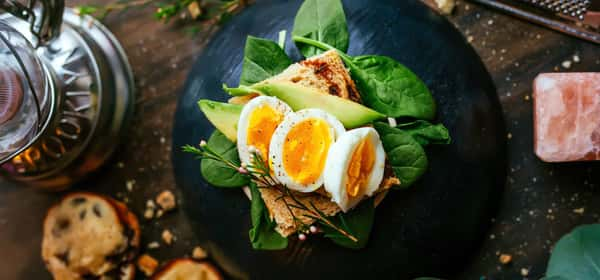
The practical lesson isn’t “eat only carbs.” It’s that pairing tryptophan sources with quality carbohydrates does more for brain serotonin than eating protein in isolation. Oats with seeds, a rice-and-tofu bowl, whole-grain toast with eggs — these combinations work with the biology rather than against it.
Suggested read: Natural GLP-1: Foods and Habits That Raise It
Plant-based eaters and tryptophan
A common worry: do vegetarians and vegans get enough tryptophan? In practice, yes. Soy foods like tofu and tempeh are complete proteins with solid tryptophan, and seeds, nuts, oats, and legumes all contribute. The bigger factor for plant-based eaters isn’t scarcity — it’s variety. Eating a range of protein sources across the day covers tryptophan comfortably.
There’s even a quiet advantage. Plant-based meals tend to come bundled with more carbohydrates than a steak-and-eggs plate, and as we just saw, carbohydrates are what give tryptophan a clearer path into the brain. A bowl of lentils and rice delivers tryptophan and the carbs that help it land where it matters. So the worry is mostly unfounded, provided you eat enough total food and don’t restrict severely.
Does cooking change anything?
Not in any way you need to manage. Tryptophan is reasonably stable, and normal cooking doesn’t meaningfully destroy it. What matters far more is the overall composition of the meal — the protein-to-carb balance — than how you prepare any single ingredient. You don’t need to eat foods raw or hunt for special preparation tricks to “preserve” tryptophan. Eat normal, varied, balanced meals and the amino acid takes care of itself.
A serotonin-friendly plate
If you want to eat in a way that supports the pathway:
- Include tryptophan sources — eggs, fish, poultry, tofu, seeds across your meals
- Pair them with quality carbs — whole grains, oats, legumes, starchy vegetables
- Don’t fear the carbs at dinner — a balanced evening meal with some carbohydrate may support the wind-down toward sleep
- Eat consistently — severe undereating drops tryptophan availability and can worsen mood1
This dovetails with the wider eating patterns in mood foods, stress-relieving foods, and foods that reduce anxiety, which all lean on the same principle: whole, balanced meals beat single “magic” ingredients.
Suggested read: Why You're Tired After Eating & How to Avoid It
What food can’t do
Diet supports serotonin production, but it doesn’t act like a drug. A few honest limits:
- No meal flips your mood in an hour through serotonin
- You can’t out-eat a clinical depression — food is supportive, not a treatment
- Supplements aren’t food — concentrated precursors like 5-HTP behave very differently and carry real risk; see 5-HTP and the serious interaction warnings in serotonin syndrome
This last point is worth dwelling on. The reason supplements like 5-HTP exist at all is precisely that food tryptophan is such an inefficient route to brain serotonin — the precursor 5-HTP skips the competition and the rate-limiting enzyme step that food can’t get past.3 But “more effective” and “safer” are not the same thing. Food carries essentially no interaction risk; a turkey dinner has never caused serotonin syndrome. Concentrated precursors can, especially alongside medication. That tradeoff — gentle and safe versus potent and risky — is the whole reason diet is the sensible starting point and supplements are a guarded, clinician-led step.
For the levers that genuinely move serotonin, food is one piece alongside light, exercise, and sleep — the full set is in how to increase serotonin naturally and sunlight and serotonin.
Bottom line
Tryptophan foods — turkey, eggs, fish, tofu, seeds, oats — supply the essential amino acid your body turns into serotonin, but eating more tryptophan doesn’t reliably raise brain serotonin. The reason is competition: protein-rich meals flood your blood with amino acids that crowd tryptophan out of the brain, while carbohydrates clear those competitors away and let more tryptophan through. So the smart move is pairing tryptophan sources with quality carbs and eating consistently, not hunting for the single highest-tryptophan food. Diet is a slow, supportive lever — not an instant serotonin switch. For the rest of the toolkit, see how to increase serotonin naturally.
Haleem DJ. Improving therapeutics in anorexia nervosa with tryptophan. Life Sciences. 2017;178:87-93. PubMed | DOI ↩︎ ↩︎
Liu L, Artigas SO, Ulrich A, et al. Eating to dare - Nutrition impacts human risky decision and related brain function. NeuroImage. 2021;233:117951. PubMed | DOI ↩︎ ↩︎
Turner EH, Loftis JM, Blackwell AD. Serotonin a la carte: supplementation with the serotonin precursor 5-hydroxytryptophan. Pharmacology & Therapeutics. 2005;109(3):325-38. PubMed | DOI ↩︎