Sauerkraut is about as simple as food gets — cabbage and salt, left to ferment — and that simplicity hides a genuinely useful gut-health tool. It’s cheap, it lasts for months, and raw versions are packed with live bacteria. But not all sauerkraut is created equal, and some of the benefits are oversold. Here’s a clear-eyed look at the real sauerkraut benefits and how to actually get them.
Quick answer: Raw, unpasteurized sauerkraut is one of the most accessible probiotic foods you can buy. Fermenting cabbage with salt creates a rich community of live lactic acid bacteria plus fiber, and research — including a trial in people with IBS — shows it can support digestion and shift the gut microbiome. The two things that matter most: buy it raw (not the shelf-stable, pasteurized kind) and keep an eye on sodium. For the wider view, see our fermented foods guide.
What makes sauerkraut a health food
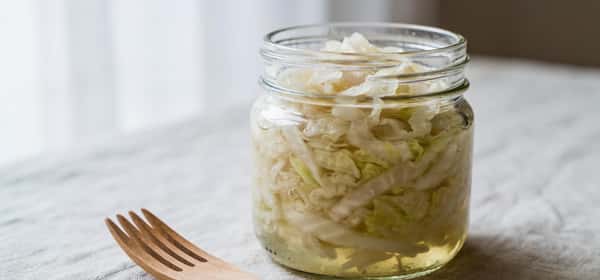
Sauerkraut is made by submerging shredded cabbage in salt and letting the naturally present bacteria do the work. In the low-oxygen, salty environment, lactic acid bacteria ferment the cabbage’s sugars into lactic acid — that’s what gives sauerkraut its sour tang and preserves it without vinegar.
A calm gut starts with the right meals. Choose your goal and get your plan.
Powered by DietGenie Eat healthy
 Lose weight
 Gain muscles
 Explore new cuisines
Those same bacteria are the payoff. Traditionally fermented sauerkraut is loaded with live probiotics, the beneficial microbes that interact with your gut. Along the way, fermentation also makes some of the cabbage’s nutrients more available and produces beneficial compounds the raw vegetable didn’t have.
The gut and digestion benefits
This is where sauerkraut earns its reputation. In a randomized, double-blind pilot study, people with irritable bowel syndrome who ate sauerkraut daily for six weeks saw significant improvement in their IBS symptoms, along with measurable changes in their gut microbiota.1 Interestingly, both pasteurized and unpasteurized sauerkraut helped, which suggests some of the benefit comes from the fiber and fermentation compounds, not just the live bacteria alone.
More broadly, researchers point to fermented vegetables like sauerkraut as a low-risk, food-first option for supporting gut health, thanks to the immune-modulating and digestive properties of their lactic acid bacteria.2 And a Stanford trial found that eating more fermented foods over 17 weeks increased gut microbiome diversity and lowered inflammatory markers — a genuinely notable result.3
To feed the bacteria you’re adding, pair sauerkraut with prebiotic foods and see our guide on ways to improve gut bacteria.

What’s in sauerkraut nutritionally
Beyond probiotics, sauerkraut is a low-calorie, nutrient-dense food. A serving provides:
- Fiber that supports regularity and feeds gut microbes
- Vitamin C — historically, sauerkraut was carried on long sea voyages to prevent scurvy
- Vitamin K (including some vitamin K2 produced during fermentation — more on K2 in our vitamin K2 guide)
- Antioxidant plant compounds from the cabbage, which support its anti-inflammatory potential
- Small amounts of iron and manganese
All of that for almost no calories makes it an easy nutritional add-on.
Raw vs pasteurized: this is the key decision
Here’s the single most important thing to know about buying sauerkraut. The shelf-stable cans and jars in the center aisle are usually pasteurized — heated to kill bacteria for a long shelf life. That process also kills the probiotics.
If live cultures are what you’re after, buy refrigerated, raw, unpasteurized sauerkraut (the label will usually say “raw” or “live cultures,” and it’ll be in the cold section). Pasteurized sauerkraut still has fiber and some nutrients — and, per the IBS study, may still help digestion — but you lose the live-probiotic edge. Better yet, make your own: cabbage, salt, a jar, and a few weeks is all it takes.
Fermented sauerkraut vs vinegar “pickled” cabbage
This trips a lot of people up. True sauerkraut is fermented — cabbage and salt, transformed by live bacteria over days or weeks. Some products labeled sauerkraut (and most quick “pickled” cabbage) are instead made with vinegar, which delivers the sour taste without any fermentation or live cultures.
Vinegar-based cabbage isn’t bad for you — it’s just not a probiotic food. If gut benefits are the goal, check the ingredient list: real fermented sauerkraut lists little more than cabbage and salt, needs refrigeration, and often says “raw” or “live cultures.” If you see vinegar high on the list and the jar is shelf-stable, you’re buying a pickle, not a ferment.
The sodium caveat
Salt is essential to sauerkraut — it drives the fermentation and keeps the wrong microbes out — which means sauerkraut is a salty food. In the small portions it’s traditionally eaten (a forkful or two as a side), that’s a non-issue. Eaten in large amounts, the sodium adds up.
A large Japanese cohort found that high intake of salty fermented foods and high overall sodium were associated with increased gastric cancer risk.4 So the sensible approach is the traditional one: sauerkraut as a tangy side or topping, not a bowl-sized serving. If you’re watching blood pressure, factor the salt into your daily total.
How to eat sauerkraut for the benefits
- Buy it raw and refrigerated, or make your own, to keep the live cultures.
- Eat it cold or added after cooking — heat kills the probiotics, so don’t boil it into a dish if you want the bacteria.
- Start with a tablespoon or two and build up; a sudden fiber-and-bacteria increase can cause temporary bloating (probiotics side effects).
- Be consistent. A little most days does more than a big serving once a week.
- Use the brine too — the liquid is full of the same beneficial bacteria; a splash makes a great salad-dressing base.
Suggested read: Kimchi vs Sauerkraut: Which Is Healthier?
The bottom line
Sauerkraut is a rare thing: a health food that’s genuinely cheap, keeps for ages, and has real evidence behind it. Raw, unpasteurized sauerkraut delivers live probiotics and fiber that support digestion and the gut microbiome — a trial even found it eased IBS symptoms — and fermented foods as a group boost microbial diversity and lower inflammation.
The whole game is buying it raw rather than pasteurized, eating it cold in modest amounts, and staying mindful of the salt. Do that consistently and fermented cabbage becomes one of the easiest gut-friendly habits you can build. See how it compares to its spicy cousin in our kimchi vs sauerkraut guide, or explore the full fermented foods roundup.
Nielsen ES, Garnås E, Jensen KJ, et al. Lacto-fermented sauerkraut improves symptoms in IBS patients independent of product pasteurisation - a pilot study. Food Funct. 2018;9(10):5323-5335. PubMed ↩︎
Garnås E. Fermented Vegetables as a Potential Treatment for Irritable Bowel Syndrome. Curr Dev Nutr. 2023;7(3):100039. PubMed ↩︎
Wastyk HC, Fragiadakis GK, Perelman D, et al. Gut-microbiota-targeted diets modulate human immune status. Cell. 2021;184(16):4137-4153.e14. PubMed ↩︎
Umesawa M, Iso H, Fujino Y, Kikuchi S, Tamakoshi A. Salty Food Preference and Intake and Risk of Gastric Cancer: The JACC Study. J Epidemiol. 2016;26(2):92-97. PubMed ↩︎