Rutin doesn’t get the spotlight that some flavonoids do, but if you’ve ever looked into supplements for tired, heavy legs or visible veins, you’ve probably crossed paths with it. Rutin is a bioflavonoid — chemically, it’s quercetin with a sugar attached — and it’s been used for decades, mostly in Europe, to support blood vessels and circulation. Here’s what it actually does, the foods that deliver it, and a clear-eyed look at how strong the evidence is.
Quick answer
- What it is: a flavonoid also called rutoside or quercetin-3-rutinoside — quercetin bound to a sugar
- Main interest: vein and capillary support, circulation, antioxidant and anti-inflammatory activity
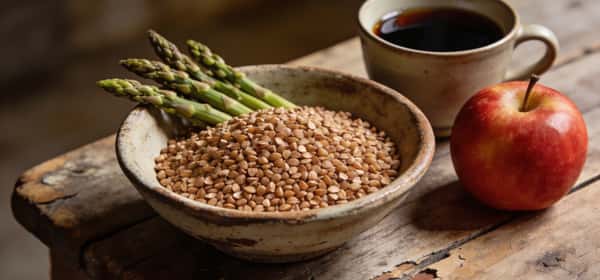
- Best food sources: buckwheat, capers, asparagus, apple peel, citrus, and black tea
- Typical supplement dose: roughly 250–500 mg/day, often as a rutoside in vein formulas
- Related forms: hydroxyethylrutosides (oxerutins) are studied for chronic venous insufficiency
- Evidence: strongest for venous symptoms; much of the rest is lab and animal work
- Generally safe; the main caution is its mild effect on blood clotting
What rutin is
Rutin belongs to the flavonol group of flavonoids. The simplest way to think about it: it’s quercetin with a rutinose sugar attached, which is why you’ll also see it written as quercetin-3-rutinoside. That sugar changes how it behaves in the body compared to plain quercetin.
A detailed review of rutin describes a compound that’s widely distributed in plants and acts on a range of biological targets — it has antioxidant, anti-inflammatory, and other activities, and it interacts with inflammatory and cell-signaling pathways involved in conditions like cardiovascular disease and cancer.1 Most of that mechanistic work is from cell and animal studies, so it sets up the “why it might help” rather than proving clinical effects in people.
Choose your goal and get a meal plan that considers your heart health.
Powered by DietGenie Eat healthy
 Lose weight
 Gain muscles
 Explore new cuisines
Rutin sits in the same broad family as the other compounds in our quercetin pillar guide — it’s essentially a relative of quercetin with its own niche around the vascular system.
Why rutin is linked to vein and vessel health
The headline use for rutin and its derivatives is venous support — the kind of thing people reach for with heavy, achy legs, mild swelling, or the early signs of varicose veins. The idea is that these flavonoids help strengthen capillary walls, reduce leakiness, and calm the low-grade inflammation that comes with poor venous return.
The most relevant clinical evidence is for hydroxyethylrutosides (also called oxerutins or Venoruton), which are semi-synthetic rutin derivatives. A 2025 systematic review and meta-analysis of pharmacological treatments for chronic venous insufficiency found that hydroxyethylrutoside produced significant benefits for pain reduction and improved blood flow, alongside Pycnogenol, though the authors flagged high variability between studies and the need for larger, better-designed trials.2
A separate 2025 systematic review of venoactive compounds — the drug class that includes rutosides, diosmin, and the micronized purified flavonoid fraction — concluded they had at least moderate-quality evidence for improving venous symptoms, reducing swelling, and helping venous ulcers heal.3 Rutin derivatives are part of that established venoactive toolkit, mostly outside the US.
There’s also an intriguing thread on blood clotting. Researchers identified quercetin-3-rutinoside (rutin) as an inhibitor of protein disulfide isomerase, an enzyme needed for normal clot formation — and it blocked thrombus formation in animal models at doses in the range people take as supplements. That’s promising early science pointing toward a potential antithrombotic role, but it’s not yet clinical practice.4
If your interest is veins specifically, the closely related citrus flavonoid is worth comparing — see hesperidin, which is the standard partner of diosmin in vein formulas.
Food sources of rutin
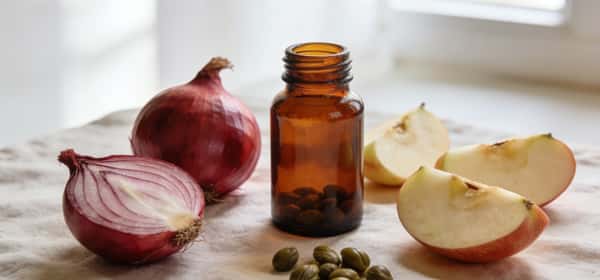
Rutin is one flavonoid you can meaningfully get from food, and the standout source is buckwheat — it’s one of the richest natural sources around. Here’s where it shows up:
| Food | Notes |
|---|---|
| Buckwheat (groats, flour, soba) | One of the richest dietary sources of rutin |
| Capers | Very high flavonol content |
| Asparagus | Good source, especially cooked |
| Apple peel | Concentrated in the skin — don’t peel it |
| Citrus fruits | Oranges, lemons, grapefruit contribute rutin and related flavonoids |
| Black and green tea | Reliable everyday source |
| Figs, berries, red onion | Smaller but useful amounts |
A diet built around these won’t match a concentrated rutoside supplement, but it’s a sensible everyday baseline — and these foods bring plenty of other benefits with them. See anti-inflammatory foods, health benefits of apples, and health benefits of green tea for overlap.
Suggested read: Citicoline (CDP-Choline): Attention, Memory, Dosing
How to use rutin
There’s no official recommended intake, since rutin isn’t an essential nutrient. Typical patterns from supplements and vein products:
- Plain rutin / rutoside: commonly 250–500 mg/day, sometimes more
- Hydroxyethylrutosides (oxerutins): studied for venous insufficiency at higher, standardized doses — follow the product or your clinician’s guidance
- Pairing: rutin shows up alongside diosmin, hesperidin, and vitamin C in vein and capillary formulas
- Consistency over timing: like most flavonoids, any vascular benefit builds with regular use over weeks, not from a single dose
If you’re dealing with significant leg swelling, painful varicose veins, or possible blood clots, that’s a reason to see a doctor — not to self-treat with a supplement. Rutin products are at best a complement to proper care, and compression and movement remain first-line for venous symptoms.
Safety
Rutin is generally considered safe, with food intake posing essentially no concern and supplements being well tolerated for most people. A few things to keep in mind:
- Blood clotting: given rutin’s effect on clot-related enzymes, be cautious if you take blood thinners or antiplatelet drugs, and mention it before surgery.
- Pregnancy and breastfeeding: there isn’t enough safety data on supplement-level doses, so it’s best to stick to food sources.
- Medication interactions: as with other flavonoids, check with your pharmacist if you take prescription drugs.
Mild digestive upset or headache are the most commonly reported side effects, and they’re uncommon.
Suggested read: Compression Boots: Do Recovery Boots Actually Work?
Bottom line
Rutin is a quietly useful bioflavonoid — basically quercetin with a sugar attached — with its clearest role in vein and blood-vessel support. Its derivatives, the hydroxyethylrutosides, have moderate-quality evidence for easing the symptoms of chronic venous insufficiency, and there’s interesting early science suggesting rutin may influence blood clotting. Most of its broader claims still rest on lab and animal work, so keep expectations realistic and treat it as a complement to good vascular care rather than a fix. The good news is you can get real amounts from food — buckwheat, capers, apple peel, citrus, and tea are all solid sources. For the wider flavonoid family, see the quercetin pillar, and for the related vein-support compounds, hesperidin and bromelain.
Nouri Z, Fakhri S, Nouri K, Wallace CE, Farzaei MH, Bishayee A. Targeting Multiple Signaling Pathways in Cancer: The Rutin Therapeutic Approach. Cancers (Basel). 2020;12(8):2276. PubMed | DOI ↩︎
Miguel CB, Andrade RS, Mazurek L, et al. Emerging Pharmacological Interventions for Chronic Venous Insufficiency: A Comprehensive Systematic Review and Meta-Analysis of Efficacy, Safety, and Therapeutic Advances. Pharmaceutics. 2025;17(1):59. PubMed | DOI ↩︎
Gloviczki ML, Stoughton J, Puggioni A, Gloviczki P, Raffetto JD. Utility of venoactive compounds in post-thrombotic syndrome: A systematic review. J Vasc Surg Venous Lymphat Disord. 2025;13(4):102228. PubMed | DOI ↩︎
Flaumenhaft R. Protein disulfide isomerase as an antithrombotic target. Trends Cardiovasc Med. 2013;23(7):264-268. PubMed | DOI ↩︎