Red light therapy has gone from a niche dermatology tool to a glowing panel in half the gyms and bathrooms you walk past. The pitch is huge: smoother skin, faster muscle recovery, less pain, better sleep, even fat loss. Some of that holds up. A lot of it is marketing wrapped around a real but modest effect. Here’s the honest split between what red light therapy can actually do and what’s being oversold.
Quick answer
- What it is: low-intensity red and near-infrared light (photobiomodulation) absorbed by your cells, mainly the mitochondria
- Wavelengths that matter: roughly 630–680 nm (visible red, works on skin surface) and 800–880 nm (near-infrared, penetrates deeper into tissue)
- Best-supported uses: skin appearance (wrinkles, collagen, roughness) and modest help with muscle soreness and recovery
- Weak or unproven: weight loss, cellulite, hair regrowth claims, mental health, “detox”
- Heat is not the mechanism: real photobiomodulation is non-thermal — if a device mostly warms you, that’s an infrared heat lamp, not the same thing
- Safety: generally low-risk, but protect your eyes and don’t expect miracles
What red light therapy actually is
Red light therapy goes by a few names: photobiomodulation, low-level light therapy (LLLT), and the older “cold laser.” The idea is that specific wavelengths of red and near-infrared light get absorbed by a molecule in your mitochondria called cytochrome c oxidase. That nudges cells to produce a bit more ATP (cellular energy) and shifts signaling around inflammation and tissue repair.
The Cleveland Clinic describes it plainly as a treatment that uses low levels of red light to act on the “power plant” of your cells, and notes most experts still don’t know whether it works for every claimed use.1 That’s the honest framing to keep in mind: a real mechanism, a narrow band of solid evidence, and a wide halo of hype.
Choose your goal and get a personalized meal plan in minutes.
Powered by DietGenie Eat healthy
 Lose weight
 Gain muscles
 Explore new cuisines
Two things separate legitimate photobiomodulation from a glorified heat lamp:
- Wavelength specificity. Red (~630–680 nm) and near-infrared (~800–880 nm) are the bands with the most research. Red works closer to the skin surface; near-infrared penetrates deeper toward muscle and joints.
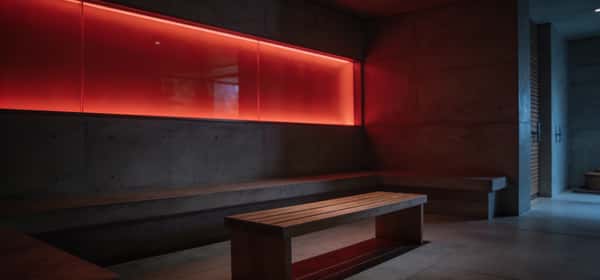
- It’s non-thermal. The effect comes from light absorption, not from warming tissue. If a panel’s main feature is that it feels hot, you’re getting infrared heat — closer to a sauna than to photobiomodulation. (For actual heat-based recovery, see infrared sauna vs traditional sauna.)
What the evidence supports: skin
This is the strongest area. In a randomized controlled trial of 136 people, treatment with red (611–650 nm) or broader red/near-infrared (570–850 nm) light twice a week improved skin complexion, reduced measured skin roughness, and increased intradermal collagen density compared with untreated controls.2 Blinded reviewers of before-and-after photos confirmed the improvement.
So the skin claims aren’t fantasy. Realistic expectations:
- Modest reductions in fine lines and roughness
- Measurable collagen density increase over weeks of consistent sessions
- It’s gradual, not a one-session transformation
What red light therapy is not for the skin: a replacement for sunscreen, a wrinkle eraser, or a fix for deep structural aging that only procedures address.
What the evidence supports: muscle recovery
Here the picture is “promising but conditional.” A 2024 meta-analysis of 34 randomized controlled trials found that photobiomodulation applied before exercise improved muscle endurance (moderate effect) and sped up recovery of muscle strength, while also lowering markers of muscle damage like creatine kinase.3
The catch is who it helps. Those benefits showed up in athletes and in sedentary, untrained people — but not in already physically active recreational exercisers. So if you train regularly but aren’t a competitive athlete, the recovery payoff may be small. Light is one tool among many, and basics like sleep, muscle-recovery foods, and smart programming matter more.
If you also use cold for recovery, it’s worth understanding how that works on its own — see cold plunge benefits and the timing question in cold plunge before or after a workout.
What’s overblown
| Claim | Reality |
|---|---|
| Melts fat / spot reduction | No credible evidence; the Cleveland Clinic specifically lists weight loss as unsupported1 |
| Cures cellulite | Not supported |
| Boosts mood / treats depression | No solid clinical evidence at consumer-device level |
| “Detoxes” the body | Not a real mechanism |
| Regrows hair dramatically | Some LLLT data for hair exists, but consumer panels rarely match study devices or doses |
| Works through clothing, far away, in seconds | Dose and distance matter; vague exposure means a vague effect |
A useful rule: the better-evidenced uses (skin, pre-exercise recovery) come from controlled doses at specific wavelengths and distances. The hype claims tend to skip dose entirely.
Suggested read: Colostrum for Skin: What the Evidence Shows
How to use it sensibly
If you want to try it, the variables that actually matter are wavelength, distance, and time.
- Pick the right wavelengths. Look for devices specifying red (~630–680 nm), near-infrared (~800–880 nm), or both. “Red glow” alone tells you nothing.
- Mind the distance. Most panels are designed for use roughly 6–18 inches away. Too far and the dose drops off fast.
- Keep sessions short and consistent. Typical protocols run a few minutes per area, several times a week. More is not better — light therapy has a dose-response sweet spot, and overdoing it can blunt the effect.
- Be patient. Skin and recovery effects build over weeks, not days.
- Bare skin for skin goals. Clothing blocks the relevant wavelengths.
Red vs near-infrared: which to pick
Most quality panels offer both red and near-infrared, and the reason is depth. The two bands aren’t interchangeable — they reach different tissue.
- Red (~630–680 nm) is absorbed close to the surface. It’s the band most studied for skin: complexion, fine lines, collagen density. If your goal is how your face looks, red is doing most of the work.
- Near-infrared (~800–880 nm) penetrates deeper, toward muscle, tendon, and joint tissue. It’s the band more relevant to recovery and deeper aches, since visible red barely reaches there.
So if you’re chasing skin benefits, red matters most; for muscle and joint recovery, near-infrared is the band that actually gets to the target. A combined panel covers both, which is why most serious devices include them together. What you don’t want to do is assume any red glow delivers near-infrared depth — it doesn’t, and the dose still has to be in a sensible range to matter.
Safety and who should be careful
Red light therapy is low-risk for most people, but a few cautions are real:
Suggested read: Methylene Blue Benefits: What Research Actually Shows
- Protect your eyes. Don’t stare into the panel. The Cleveland Clinic notes that misuse, including unprotected eyes, can cause damage.1 Use the goggles that come with the device or keep your eyes closed and turned away.
- Photosensitizing medications. Some drugs (certain antibiotics, acne medications, St. John’s Wort) increase light sensitivity. Check with your doctor.
- Skin conditions and pregnancy. If you have an active skin condition, lupus, or are pregnant, ask a clinician before starting.
- Skip overheating devices for “light therapy” goals. If a unit mostly produces heat, you’re not getting photobiomodulation. That’s fine if you want warmth — just don’t expect the light-specific effects.
Bottom line
Red light therapy is a real thing with a real mechanism, not snake oil — but its honest lane is narrower than the marketing suggests. The best evidence is for skin (collagen, roughness, fine lines) and for modest muscle-recovery and endurance benefits, especially when light is applied before exercise and especially in athletes or untrained people. Claims about fat loss, cellulite, detox, and mental health aren’t backed at the consumer-device level. If you use it, focus on the right wavelengths (~630–680 nm and ~800–880 nm), reasonable distance, short consistent sessions, and eye protection. Treat it as a small bonus on top of the fundamentals — sleep, training, and muscle-recovery nutrition — not a substitute for them. For other recovery tools worth comparing, see pneumatic compression boots, percussion massage, and EMS devices.
Cleveland Clinic. Red Light Therapy. Cleveland Clinic Health Library. Link ↩︎ ↩︎ ↩︎
Wunsch A, Matuschka K. A controlled trial to determine the efficacy of red and near-infrared light treatment in patient satisfaction, reduction of fine lines, wrinkles, skin roughness, and intradermal collagen density increase. Photomed Laser Surg. 2014;32(2):93-100. PubMed | DOI ↩︎
Li BM, Qiu DY, Ni PS, et al. Can pre-exercise photobiomodulation improve muscle endurance and promote recovery from muscle strength and injuries in people with different activity levels? A meta-analysis of randomized controlled trials. Lasers Med Sci. 2024;39(1):132. PubMed | DOI ↩︎