If you’ve ever wondered why night-lights, sleep apps, and even submarine control rooms lean on red light at night, there’s real biology behind it. Your body clock barely “sees” long-wavelength red light, so it’s far gentler on melatonin than the white or blue light most homes blast in the evening. It’s not a magic sleep button, but as a way to keep your nights dim and your clock undisturbed, warm red light is a smart, cheap choice.
Quick answer
- Red light suppresses melatonin far less than blue or white light, because the eye’s clock-setting cells are tuned to short wavelengths around 480 nm, not red.
- It’s about wavelength and dimness together. Warm, dim, long-wavelength light is the least disruptive combination for the evening.
- It’s not a sleep aid. Red light won’t make you sleepy — it just gets out of melatonin’s way.
- Best uses: night-lights, bathroom trips, the last hour before bed.
- Daytime is the opposite. You want bright, blue-rich light during the day; save the red for night.
Why red is gentle: the biology
Your body clock isn’t set by the cells you see with. It’s set by the melanopsin-containing retinal ganglion cells (ipRGCs), which report ambient light to the brain’s master clock. These cells peak in sensitivity around 480 nm — blue-green — and respond weakly to long-wavelength red light.1
So when you sit under warm red light at night, those cells fire much less. Less firing means less of the “it’s still daytime” signal, which means less melatonin suppression. Blue and white light, packed with short wavelengths, hit those cells hard. That’s the whole story in one sentence: red light is quiet on the pathway that controls your clock.
What you eat affects how you sleep. Choose your goal and get your plan.
Powered by DietGenie Eat healthy
 Lose weight
 Gain muscles
 Explore new cuisines
A systematic review of light and circadian rhythm confirmed the pattern — melatonin suppression is strongest at the shortest wavelengths and the maximum effect appears in the violet-blue range.2 The flip side is that longer wavelengths are far less potent at the same brightness.
Reviews of artificial light at night reach the same conclusion from the other direction: shorter wavelengths preferentially disturb melatonin and trigger circadian phase shifts, even when the light isn’t bright.3 Long-wavelength red simply isn’t well-matched to the pigment doing the sensing, so at equal brightness it costs you far less melatonin.
For the full mechanism behind why short wavelengths dominate, see blue light and sleep.
“Less disruptive” isn’t “zero”
Here’s the honest caveat. Red is gentler, not harmless. That same review found that even the longest wavelengths (around 631 nm, red) and even dim light can produce some circadian response if it’s bright enough or timed wrong.2 Exposure to just 5–10 lux at night — eyes closed, during sleep — was enough to nudge the system in some studies.2
The practical lesson: dimness matters as much as color. A blazing red light is still light. The winning combination is warm and dim, not red at full blast. Keep evening light low (under roughly 50 lux in the spaces you use) and lean warm, and you’ve covered both levers.
There’s a second caveat worth flagging. “Red” lighting in the real world is rarely pure red — most warm bulbs and amber night-lights still emit a spread of wavelengths, including some in the blue-green range your clock cares about. That’s fine; the point isn’t to chase a perfect monochrome red. It’s to shift the balance away from short wavelengths and turn the brightness down. A warm 2,000K amber bulb at low output does that job well without any special equipment.
Color temperature, in plain terms
Light “color” is measured in Kelvin (K). Lower numbers are warmer and more red/orange; higher numbers are cooler and more blue.
| Light source | Approx. color temp | Evening verdict |
|---|---|---|
| Candle / dim amber bulb | ~1,800–2,000K | Best |
| Warm incandescent / “soft white” | ~2,700K | Good |
| Warm LED | ~3,000K | Acceptable |
| Neutral / “cool white” LED | ~4,000K | Avoid late |
| Daylight LED, most screens | ~5,000–6,500K | Daytime only |
| Midday sky | ~6,500K+ | Daytime only |
For the evening, aim for under 3,000K and keep it dim. Red and amber sit at the gentle end; cool white and daylight bulbs are the ones to push earlier in your day.
Suggested read: Screen Time Before Bed: How It Affects Your Sleep
Where red light actually helps
Red and amber light shine in specific roles:
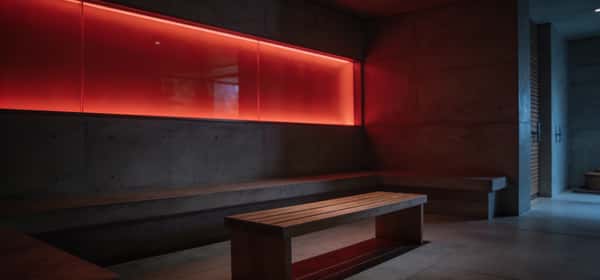
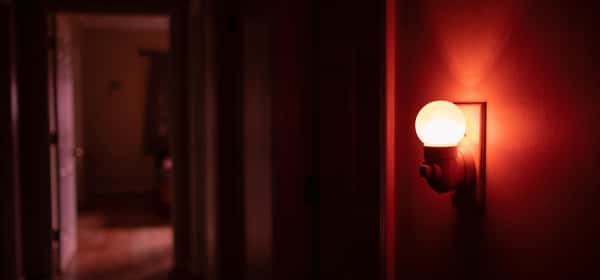
- Night-lights. A dim red night-light lets you see without waking your clock.
- Bathroom trips. Swap the bright overhead for a warm, dim source so a 3 a.m. trip doesn’t reset your night.
- The last hour before bed. Reading or relaxing under warm, low light keeps melatonin rising.
- Kids’ rooms. A warm, dim night-light is friendlier to a child’s sleep than a bright white one.
What red light won’t do: it won’t sedate you, cure insomnia, or override a late bedtime and a stressful mind. It removes one obstacle to sleep — it doesn’t create sleep. If you’re chasing deeper help, see natural sleep aids, magnesium and sleep, and melatonin (plus its side effects before you start).
It’s also worth being realistic about how much any single change does. Swapping to red night-lights is a small, reliable win — but if you then sit under bright overhead lights until midnight, scroll a stressful feed in bed, and skip daylight entirely, the night-light won’t rescue your sleep. Red light pulls its weight only as one piece of a consistent evening routine, alongside dimming the room and getting bright light earlier in the day.
Suggested read: Jet Lag Remedies: Light, Melatonin, Direction Rules
Setting up gentle evening light
A simple, no-gadget approach:
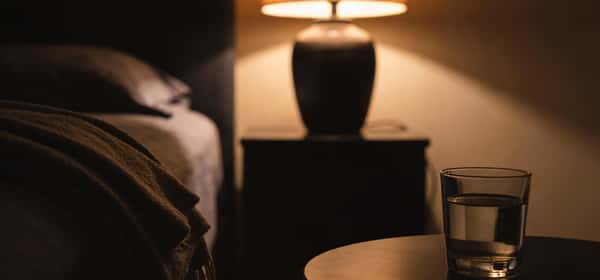
- Dim everything in the evening. Use lamps instead of overhead lights for the last 2–3 hours.
- Go warm. Choose bulbs under 3,000K, or amber/red for night-lights.
- Lower screen brightness and turn on warm night modes. They’re a small help, not a substitute for dimming the room.
- Use a warm, dim night-light for the bathroom and hallways.
- Make the bedroom dark for actual sleep — red night-lights are for navigating, not for sleeping under.
This is the evening half of a full light-hygiene routine; the daytime half (bright light early) is just as important. See circadian lighting for the complete day-to-night plan, and pair the routine with tips to sleep better and ways to fall asleep.
A note on red-light therapy panels
Don’t confuse warm room lighting with red-light therapy devices (photobiomodulation panels). Those are a separate topic with their own (still-emerging) research, mostly studied for skin and muscle recovery. This article is about ambient red light for protecting your evening clock — that benefit comes simply from the wavelength being gentle, no special device needed.
Bottom line
Red light at night is gentler on sleep because your clock-setting eye cells are tuned to short blue-green wavelengths and barely register long-wavelength red. Swap cool white evening light for warm, dim, red or amber light and you suppress far less melatonin. But remember two caveats: even red light isn’t truly zero at high intensity, and dimness matters as much as color — so keep evenings warm and low. Use red for night-lights, bathroom trips, and the last hour before bed. It’s a cheap, low-effort way to stop your lighting from working against you, as long as you don’t expect it to do the sleeping for you.
Price LLA, Blattner P. Circadian and visual photometry. Progress in Brain Research. 2022;273(1):1-11. PubMed | DOI ↩︎
Tähkämö L, Partonen T, Pesonen AK. Systematic review of light exposure impact on human circadian rhythm. Chronobiology International. 2019;36(2):151-170. PubMed | DOI ↩︎ ↩︎ ↩︎
Cho Y, Ryu SH, Lee BR, et al. Effects of artificial light at night on human health: a literature review of observational and experimental studies applied to exposure assessment. Chronobiology International. 2015;32(9):1294-1310. PubMed | DOI ↩︎