If you’ve gone down the rabbit hole of “natural antihistamines,” you’ve almost certainly run into quercetin. It shows up in allergy formulas, gets bundled with bromelain and vitamin C, and gets talked about like it’s a gentle stand-in for your usual hay fever pill. So does quercetin for allergies actually do anything, or is it just clever marketing on top of a plant pigment? The short version: there’s a real mechanism and some genuinely encouraging human data, but it’s not a replacement for the medication that’s keeping your nose from running.
Quick answer
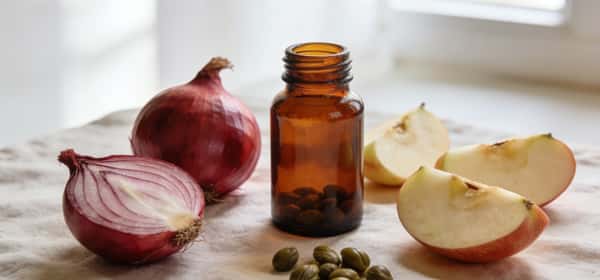
- What it is: quercetin is a flavonoid (a plant pigment) found in onions, apples, capers, and tea
- How it helps allergies: it stabilizes mast cells, the immune cells that dump histamine during an allergic reaction
- Best evidence for: seasonal allergic rhinitis (hay fever) — reduced sneezing, itching, nasal symptoms
- Typical dose: 200–1,000 mg/day, often started a few weeks before allergy season
- Bioavailability matters: plain quercetin is poorly absorbed; phytosome or enzyme-treated forms absorb better
- Honest take: evidence is promising but rated low certainty; treat it as a complement, not a swap for prescribed meds
- Don’t stop your meds to try it, especially if you have asthma or severe allergies
How quercetin works as a “natural antihistamine”
Calling quercetin an antihistamine is a little loose, but it points at something real. When you’re allergic to pollen or dust, your immune system loads up mast cells with histamine and other inflammatory chemicals. Exposure to the allergen triggers those cells to degranulate — basically to burst and release their contents — and that’s what gives you the sneezing, the itch, the runny nose, the watery eyes.
Quercetin works upstream of that. In lab studies it acts as a mast-cell stabilizer, making those cells less likely to dump their histamine in the first place. That’s a different angle than a standard antihistamine like cetirizine, which mostly blocks the histamine receptor after the histamine is already out. So in theory the two could even complement each other.
Strong defenses start with good meals. Choose your goal and get your plan.
Powered by DietGenie Eat healthy
 Lose weight
 Gain muscles
 Explore new cuisines
The catch is that most of the strongest mast-cell evidence comes from test-tube and animal work. The question is always whether it translates to a real human nose during real pollen season.
For the full picture on what quercetin is and its other effects beyond allergies, our quercetin pillar guide covers benefits, food sources, and safety in depth.

What the human trials actually show
Here’s where you have to be honest. The allergy data on quercetin is encouraging but still thin.
A 2022 randomized, placebo-controlled, double-blind trial gave 66 Japanese adults with pollen allergy either 200 mg of a bioavailable quercetin (a phytosome formulation) or placebo daily for four weeks. The quercetin group reported significantly better scores for eye itching, sneezing, nasal discharge, and even sleep, with no serious side effects.1
Zoom out and a 2025 systematic review and meta-analysis pooled 13 randomized trials (823 people) on polyphenols — a group that includes quercetin and green-tea catechins — for allergic rhinitis. In seasonal allergy sufferers, the compounds significantly cut total nasal symptom scores, sneezing, and nasal itching. But the authors graded the overall certainty of evidence as low to very low, mostly because the trials were small and inconsistent, and they found no significant effect on quality of life.2
There’s also a neat little study on shallots — which are rich in the same quercetin compounds as onions. Adding 3 g of shallot per day to cetirizine improved overall allergic rhinitis symptoms more than cetirizine alone, hinting that quercetin-rich foods may add something on top of standard treatment.3
So the honest reading: quercetin probably helps some people with hay fever symptoms, the effect is modest, and the evidence isn’t strong enough to call it proven. That’s a fair distance from the breathless “natural Zyrtec” framing you’ll see online.
Suggested read: Berberine Benefits: 7 Effects Backed by Research
The bioavailability problem
If you do try quercetin, the form matters more than people realize. Plain quercetin aglycone — the cheap powder in a lot of capsules — is poorly absorbed. Your gut just doesn’t take much of it up, which is part of why study results are all over the place.
That’s why better supplements pair it with absorption helpers or use a modified form:
| Form / pairing | Why it’s used |
|---|---|
| Quercetin phytosome | Bound to phospholipids; markedly better absorption (used in the positive 2022 trial) |
| Quercetin + bromelain | Bromelain is a pineapple enzyme thought to aid uptake and add anti-inflammatory effect |
| Quercetin + vitamin C | Vitamin C may help recycle and stabilize quercetin |
| Enzymatically modified (isoquercitrin) | More water-soluble, better absorbed than plain quercetin |
If you want the deeper dive on the pineapple enzyme that’s so often packaged with quercetin, see our guide to bromelain.
How to use it sensibly
There’s no official allergy dose, but here’s what the research and common formulas point to:
- Typical range: 200–1,000 mg/day. The positive hay fever trial used just 200 mg of a well-absorbed form; many supplements use 500 mg once or twice daily.
- Timing: start it 2–4 weeks before your allergy season kicks off. Mast-cell stabilization isn’t instant — it’s more of a build-up effect than an as-needed rescue.
- Pairing: a quercetin + bromelain + vitamin C combo is the most common allergy stack, and it lines up with the absorption logic above.
- Food-first option: you genuinely get quercetin from food — onions, capers, apples, kale, berries, and tea are all solid sources. A produce-heavy diet won’t match a supplement dose, but it’s a reasonable everyday baseline. See foods for healthy skin and anti-inflammatory foods for overlapping picks.
A reasonable experiment: start a well-absorbed quercetin a few weeks before pollen ramps up, keep taking your usual allergy meds, and see whether you can get by with less of the medication. Don’t expect a miracle, and give it the full few weeks before deciding.
Suggested read: Citrulline Malate: Pump, Nitric Oxide, and Dosing
The caveats that actually matter
This is the part the supplement ads skip.
It is not a replacement for prescribed allergy medication. If antihistamines, nasal steroids, or an inhaler are part of your routine — especially if you have asthma — quercetin is at most an add-on. Stopping real medication to “go natural” can land you in trouble during a bad season.
Drug interactions are real. A safety review of quercetin as a supplement flagged that it can alter how certain drugs are processed, changing their levels in your blood. It may interact with some antibiotics, blood pressure medications, and blood thinners.4 If you take prescription meds, run it past your doctor or pharmacist first.
High doses aren’t automatically better. The same review found that adequate long-term safety data for high doses (1,000 mg or more for over 12 weeks) just isn’t there, and noted potential concerns around the kidneys in people with pre-existing damage.4 More is not the move.
Skip it if you’re pregnant or breastfeeding. Quercetin in food is fine, but there isn’t enough safety data on supplement-level doses during pregnancy or nursing.
Bottom line
Quercetin for allergies isn’t snake oil, but it isn’t a cure either. It’s a flavonoid with a legitimate mast-cell-stabilizing mechanism, and human trials — including a solid placebo-controlled study and a 2025 meta-analysis — suggest it can take the edge off seasonal hay fever symptoms like sneezing and itching. The honest qualifier is that the evidence is rated low certainty, the effect is modest, and it’s not a substitute for the medication that’s actually controlling your allergies. If you want to try it, use a well-absorbed form (phytosome, or paired with bromelain and vitamin C), start a few weeks before your season, keep your meds going, and check for drug interactions first. For the broader story on this flavonoid, head to the quercetin pillar; for the related compounds people stack it with, see bromelain, rutin, and hesperidin.
Yamada S, Shirai M, Inaba Y, Takara T. Effects of repeated oral intake of a quercetin-containing supplement on allergic reaction: a randomized, placebo-controlled, double-blind parallel-group study. Eur Rev Med Pharmacol Sci. 2022;26(12):4331-4345. PubMed | DOI ↩︎
Lai YR, Liao YH, Huang L, et al. Clinical Effects of Polyphenolic Compounds on Allergic Rhinitis: A Systematic Review and Meta-Analysis. J Allergy Clin Immunol Pract. 2025;13(9):2475-2491.e16. PubMed | DOI ↩︎
Arpornchayanon W, Klinprung S, Chansakaow S, et al. Antiallergic activities of shallot (Allium ascalonicum L.) and its therapeutic effects in allergic rhinitis. Asian Pac J Allergy Immunol. 2022;40(4):393-400. PubMed | DOI ↩︎
Andres S, Pevny S, Ziegenhagen R, et al. Safety Aspects of the Use of Quercetin as a Dietary Supplement. Mol Nutr Food Res. 2018;62(1):1700447. PubMed | DOI ↩︎ ↩︎