The scale is moving and you’re thrilled. But here’s the part nobody mentions when you start a GLP-1: not every pound you lose is fat. Some of it is muscle, and if you don’t pay attention, that quiet loss can leave you lighter but weaker, with a body that’s primed to regain.
This is educational information, not medical advice. GLP-1 and GLP-1/GIP medicines — including semaglutide (Ozempic, Wegovy, Rybelsus), tirzepatide (Mounjaro, Zepbound), liraglutide (Saxenda, Victoza), and dulaglutide (Trulicity) — are prescription-only and must be prescribed and supervised by a licensed clinician. Versions sold online as “research use only” are not FDA-approved for human use. Never start, change, or stop a dose on your own, and never source or self-inject these drugs outside of legitimate medical care. Talk to your doctor or pharmacist first, especially if you take other medications, could become pregnant, or have a health condition.
Quick answer: When you lose weight quickly on Ozempic or a similar drug, a meaningful chunk of that loss can be lean mass — muscle, not just fat. Reviews of GLP-1 studies put it at roughly a quarter, and sometimes up to about 40 percent of total weight lost, when nothing is done to protect it.1 The fix isn’t complicated, but it does take effort: eat enough protein (and eat it first when your appetite is small), and lift something heavy two or three times a week. Do those two things and you keep far more of the muscle that makes you strong, mobile, and metabolically healthy.
Choose your goal and get a meal plan that makes losing weight simpler.
Powered by DietGenie Lose weight
 Gain muscles
 Eat healthy
 Explore new cuisines
Why some of the weight is muscle, not fat
Whenever anyone loses weight — drug or no drug — some lean mass comes along with the fat. That’s just how weight loss works. Your body doesn’t have a dial labeled “fat only.” When you’re in a calorie deficit, it pulls energy from several places, and muscle is one of them.
What makes GLP-1 medicines a special case is the speed and size of the deficit. These drugs work largely by turning down your appetite. Food gets less interesting, you fill up faster, and you simply eat less without white-knuckling it. That’s the whole appeal. But a big, sudden drop in how much you eat means two things happen at once: you’re in a steep calorie deficit, and you’re very likely under-eating protein — the one nutrient your muscle most depends on. When protein intake falls and the deficit is large, your body breaks down more muscle tissue for fuel than it would during slower, more deliberate weight loss.
Older adults are especially exposed here. Muscle is harder to hold onto as you age, and losing a chunk of it in your 60s or 70s has real consequences for balance, strength, and independence. If you’re past middle age and on a GLP-1, muscle protection isn’t optional — it’s the main event.
How much muscle are we actually talking about?
Estimates vary because studies measure body composition differently, but the pattern is consistent. Across reviews of GLP-1–based therapies, lean mass has accounted for somewhere around a quarter up to roughly 40 percent of total weight lost when no specific steps were taken to preserve it.1 So if someone drops 40 pounds, it’s plausible that 10 to 16 of those pounds came from lean tissue rather than fat.
Now layer in how much weight these drugs can move. In a large trial, tirzepatide produced average weight loss of about 20.9 percent of body weight over 72 weeks at the highest dose.2 That’s a lot of weight, and it’s exactly why the muscle question matters so much. A small amount of weight loss leaves little room for damage. A 20-percent drop does — and if a meaningful slice of that is muscle, you want to know about it and act on it from day one, not after the fact.
One honest caveat: not all lean-mass loss is bad. Some of what shows up as “lean mass” on a body-composition scan is water and connective tissue that naturally shrinks as fat cells empty out, and heavier bodies carry some extra muscle just to move around — so losing a little of that as you slim down is normal. The concern is losing functional, strength-producing muscle that you’d rather keep. That’s the part you can defend.
Suggested read: Ozempic and Hair Loss: Why It Happens, What Helps
Why losing muscle is a problem worth solving
It’s tempting to shrug this off. Lighter is lighter, right? Not quite. Muscle does a lot of jobs that don’t show up on the bathroom scale.
Strength and function are the obvious ones. Muscle is what lets you carry groceries, climb stairs, get up off the floor, and stay steady on your feet. Lose enough of it and you can end up at a lower weight but genuinely weaker, with worse stamina and a higher risk of falls and injury.
Then there’s your metabolism. Muscle is metabolically active tissue — it burns calories even at rest. When you lose muscle, your resting metabolic rate drops, which means your body needs fewer calories to maintain its new weight. That’s a big deal for what comes next.
Which brings us to regain. This is the part that loops back on itself. If you come off the medication (or your appetite returns) with less muscle and a slower metabolism, weight comes back more easily — and the regained weight tends to be fat, not the muscle you lost. Over repeated cycles, body composition drifts in the wrong direction. Protecting muscle now is one of the best things you can do for keeping the weight off later. If maintenance is on your mind, our guide to keeping weight off for good digs into that side of the equation.
(Worth noting: the same rapid fat loss that worries people about facial changes on these drugs is part of the same story. Fast, large loss affects the whole body, face and muscle included.)
How to protect your muscle: protein first
If you do one thing, make it this: get enough protein, and prioritize it at every meal.
Here’s the wrinkle that catches people out. On a GLP-1, your appetite is suppressed, so you’re eating less food overall — which makes it easy to fall short on protein without realizing it. You feel full after a few bites, push the plate away, and end up with a day that’s heavy on carbs and light on the one macronutrient that defends your muscle. Protein is also the most filling of the three macros, so when you’re only getting a small amount of food in, you want that small amount working hard.
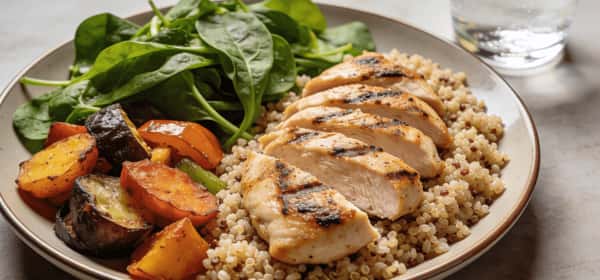
The practical move is simple: eat the protein first. When your appetite is tiny, the first few bites are the only ones you’re guaranteed to finish. Make them count. Start with the eggs, the chicken, the fish, the Greek yogurt, the tofu — and let the rest of the plate be optional. Spreading protein across all your meals, rather than loading it into one, helps your body actually use it to maintain muscle.
How much protein? That depends on your body weight and goals, and it’s a number worth getting specific about rather than guessing. Here’s a quick way to find your target:
Suggested read: Liraglutide vs Semaglutide: Daily vs Weekly GLP-1
Daily Protein Calculator
For more on building meals that hit your protein goal while keeping nausea and other side effects in check, our GLP-1 eating guide goes deep on what actually works when your appetite is low. And if side effects like nausea are getting in the way of eating well, managing GLP-1 side effects covers the practical fixes.
How to protect your muscle: lift something
Protein gives your body the raw material. Resistance training gives it the reason to use that material on muscle instead of discarding it.
This is the other half of the equation, and you can’t skip it. When you’re losing weight, your body is deciding what to keep and what to break down for fuel. Strength training sends a loud signal that your muscle is still needed — so it gets spared. Plenty of weight-loss programs lean on cardio alone, and cardio is great for your heart, but it doesn’t tell your muscles to stick around the way lifting does.
The dose that matters: aim for resistance training two to three times a week, hitting all your major muscle groups — legs, back, chest, shoulders, arms, and core. It doesn’t have to be a barbell in a gym. Dumbbells, resistance bands, weight machines, or bodyweight moves like squats, push-ups, and rows all count. What matters is that the work is genuinely challenging — the last couple of reps should feel hard. As you get stronger, the resistance needs to creep up too, or the signal fades.
If you’re new to lifting, start light and learn the movements before chasing heavier weight. Consistency over months beats heroics in week one. The goal isn’t to look like a bodybuilder; it’s to convince your body that the muscle you have is worth keeping while the fat melts off around it.
Suggested read: Tirzepatide Side Effects: GI, Risks & Hair Loss
What the research is pointing toward
The science here is moving fast, and the headline is encouraging: muscle loss on GLP-1s is not inevitable. It’s a side effect of how the weight comes off, which means it can be influenced by what you do alongside the medication.
Researchers are actively studying ways to tilt the balance toward fat loss and away from muscle loss. Work on the biology of muscle preservation during GLP-1 therapy supports the idea that combining adequate protein and muscle-preserving strategies with the drug protects lean mass — and some experimental approaches have even pushed body composition further in the right direction, preserving muscle while enhancing fat loss.3 You don’t need to wait for the next breakthrough, though. The two levers you can pull today — protein and resistance training — are the same ones the research keeps coming back to.
It’s also why these medicines are meant to be used under medical supervision rather than on your own. A clinician can track your progress, watch for warning signs, and adjust the plan — including the food and exercise side — in a way that protects more than just the number on the scale. For the bigger picture on how these drugs fit into weight loss overall, see our overview of GLP-1s for weight loss.
Bottom line
Losing weight on Ozempic or a similar GLP-1 is real progress, but the scale doesn’t tell the whole story. A meaningful share of fast weight loss can come from muscle rather than fat — roughly a quarter, sometimes more, if you do nothing to stop it. And because muscle drives your strength, your metabolism, and your odds of keeping the weight off, that loss is worth defending.
The good news is that the defense is straightforward. Eat enough protein and eat it first when your appetite is small. Lift weights two or three times a week so your body has a reason to hold onto the muscle it has. Do those two things consistently and you keep far more of your lean mass — finishing lighter and stronger, instead of just smaller. Bring your doctor into the conversation so the whole plan, not just the prescription, is working in your favor.
Neeland IJ, Linge J, Birkenfeld AL. Changes in lean body mass with glucagon-like peptide-1-based therapies and mitigation strategies. Diabetes Obes Metab. 2024;26 Suppl 4:16-27. PubMed ↩︎ ↩︎
Jastreboff AM, et al. Tirzepatide Once Weekly for the Treatment of Obesity. N Engl J Med. 2022;387(3):205-216. PubMed ↩︎
Nunn E, et al. Antibody blockade of activin type II receptors preserves skeletal muscle mass and enhances fat loss during GLP-1 receptor agonism. Mol Metab. 2024;80:101880. PubMed ↩︎