Omega-3 for fertility is one of the easier supplement recommendations — the evidence is consistent, the safety profile is excellent, and most people aren’t getting enough through food. Unlike CoQ10 (which is most useful for specific populations), basic omega-3 sufficiency matters for nearly everyone trying to conceive, both for fertility itself and for fetal development once pregnancy happens.
This guide covers what the research shows, the difference between DHA and EPA for fertility, the right dose, food versus supplement sources, and how omega-3 interacts with environmental factors in a way that’s just starting to be understood.
Quick answer
Dose for fertility and early pregnancy: 250–500 mg combined EPA + DHA per day, with at least 200 mg DHA. Best sources: Fatty fish (salmon, sardines, mackerel, anchovies, herring) 2–3 times a week, or a low-mercury supplement. Form: Triglyceride form preferred over ethyl ester for absorption. When to start: 3 months before active trying — same window as other preconception interventions. What it does: Supports oocyte and sperm health, reproductive hormone production, and fetal brain/eye development once pregnant.
Choose your goal and get a meal plan that's right for your pregnancy.
Powered by DietGenie Eat healthy
 Lose weight
 Gain muscles
 Explore new cuisines
Why omega-3 matters for fertility
Omega-3 fatty acids — specifically EPA and DHA, the marine-derived forms — are structural components of cell membranes and precursors to anti-inflammatory signaling molecules called eicosanoids. For fertility specifically:
Oocyte (egg) function:
- Cell membrane fluidity depends on omega-3 content
- DHA is highly concentrated in the cumulus cells surrounding developing eggs
- Inflammatory eicosanoids derived from omega-6 (when omega-3 is low) may impair follicle development
Reproductive hormones:
- Cholesterol and fatty acids are the substrates for steroid hormones
- Omega-3 supports balanced prostaglandin signaling
Sperm function:
- Sperm membranes are particularly rich in DHA
- Lower DHA correlates with reduced sperm motility and morphology
- Antioxidant + omega-3 combinations consistently improve sperm parameters in trials
Early pregnancy:
- DHA is the dominant omega-3 in fetal brain and retina
- Pregnancy demands roughly deplete maternal DHA stores by ~30% — starting depleted is a worse setup
What the newer research adds
A 2025 study by Shen et al. in Environmental Health Perspectives examined the interaction between serum omega-3 and environmental phthalate exposure in 351 women seeking fertility care.1 The result is striking:
- Among women with low serum omega-3, higher phthalate exposure was associated with markedly increased pregnancy loss and decreased live birth rates in IVF cycles
- Among women with middle-to-high serum omega-3, the negative effects of phthalate exposure were substantially attenuated
In numbers: in the lowest-omega-3 group, the probability of pregnancy loss went from 5% (lowest phthalate exposure) to 44% (highest phthalate exposure). In the highest-omega-3 group, that range was 14% to 11% — basically unchanged.
The mechanism is biologically plausible: both omega-3 and phthalates act on the same family of nuclear receptors (PPARs) involved in placental development. Higher omega-3 may competitively buffer the effects of phthalate exposure.
The bigger lesson: in a modern environment with constant low-level chemical exposure, having adequate omega-3 isn’t just about getting “enough” — it may help buffer against the negative effects of exposures you can’t fully avoid.
DHA vs. EPA: which matters more for fertility
Both are important. The split:
- DHA (docosahexaenoic acid): The dominant omega-3 in egg cells, sperm cells, brain tissue, and retina. The form that matters most for both fertility and fetal development.
- EPA (eicosapentaenoic acid): More involved in anti-inflammatory signaling. Important for cardiovascular and general inflammation modulation.
For fertility, prioritize DHA. Look for supplements that list at least 200 mg of DHA specifically (not just “total omega-3” or “fish oil milligrams” — those numbers can be misleading).
For more on the broader omega-3 picture, see health benefits of omega-3 and omega-3 supplement guide for general dosing and form information.
Suggested read: Inositol for PCOS: 40:1 Ratio, Dose, and How to Use
How much you actually need
The recommendations vary by source:
| Population | EPA + DHA daily |
|---|---|
| General adult women | 250–500 mg |
| Trying to conceive (preconception) | 300–500 mg, with ≥200 mg DHA |
| Pregnancy | 300–500 mg, with ≥200 mg DHA |
| Breastfeeding | 300–500 mg, with ≥200 mg DHA |
| High-dose for therapeutic effect | 1,000–2,000 mg |
For comparison: the typical Western diet provides about 50–100 mg/day of EPA + DHA combined — well below even the general recommendation, and far below what fertility-focused intake should be.
For daily intake guidance generally, see daily omega-3 intake.
Food sources of DHA and EPA
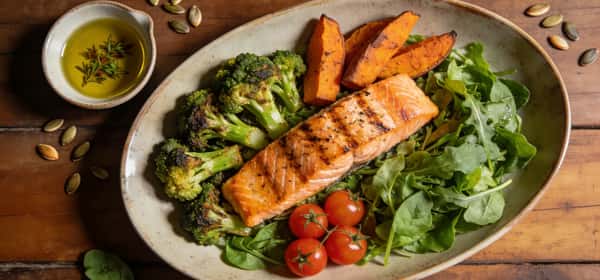
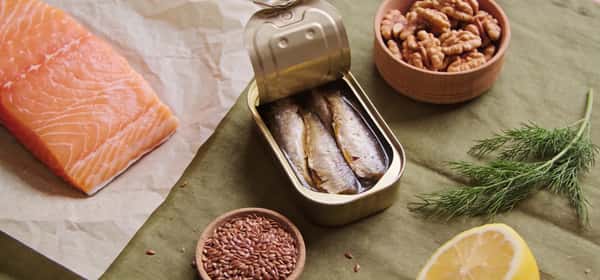
The most efficient way to hit your target: fatty fish 2–3 times a week.
| Food | EPA + DHA per serving |
|---|---|
| Salmon, wild Atlantic, 3 oz cooked | ~1,500 mg |
| Sardines, 3 oz canned | ~830 mg |
| Mackerel, Atlantic, 3 oz | ~1,000 mg |
| Anchovies, 3 oz | ~1,200 mg |
| Herring, 3 oz | ~1,500 mg |
| Trout, rainbow, 3 oz | ~900 mg |
| Tuna, light canned, 3 oz | ~230 mg |
| Cod, 3 oz | ~200 mg |
| Tilapia, 3 oz | ~150 mg |
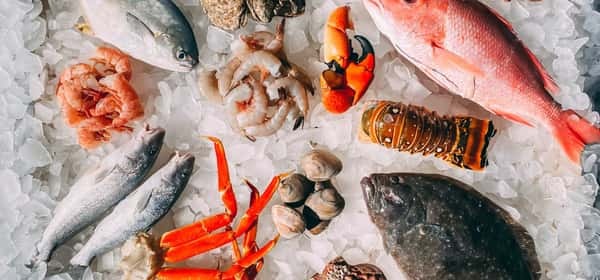
Higher omega-3 fish are smaller, oily fish — sardines, anchovies, mackerel, salmon. These also tend to be lowest in mercury.
For deep dive on fish during preconception and pregnancy: tuna in pregnancy covers the mercury question, high omega-3 foods lists the top sources.
Plant-based omega-3 (ALA): why it’s not enough
ALA (alpha-linolenic acid) — found in flax seeds, chia seeds, walnuts, hemp seeds — is technically an omega-3, but humans convert it to DHA very inefficiently (typically <5% conversion). Plant ALA is good for overall health but doesn’t reliably hit DHA targets for fertility or pregnancy.
If you’re vegan or vegetarian:
- Continue eating ALA-rich foods (flaxseed, chia, walnuts) — they’re part of a healthy diet
- Supplement with algal DHA — algae are where fish get their omega-3 in the first place. Algal DHA is the vegan equivalent of fish oil DHA and is just as bioavailable.
- 250–500 mg/day algal DHA is the typical dose for fertility/preconception
See sources of plant-based omega-3 for the broader picture.
Suggested read: Fish Oil Dosage: How Much Should You Take Per Day?
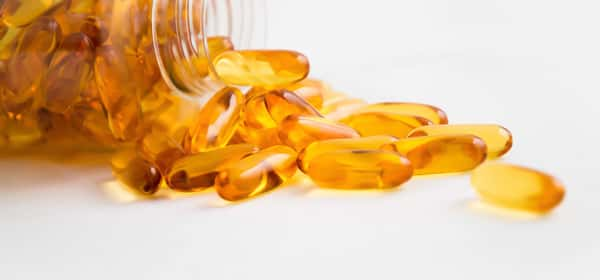
Choosing a supplement (if you don’t eat much fish)
Things that actually matter:
Form:
- Triglyceride (TG) form — best absorption; what’s naturally in fish
- Re-esterified triglyceride (rTG) — also good; concentrated
- Ethyl ester (EE) — cheaper but ~30% less absorbed than TG form
- Free fatty acid (FFA) — best absorbed but rare; more expensive
- Phospholipid (krill oil) — well-absorbed; lower DHA content per capsule
For most people, look for the words “triglyceride form” or “natural triglyceride form” on the label.
Purity:
- Third-party tested for heavy metals (mercury, lead), PCBs, and dioxins
- IFOS certification, USP verified, or NSF certified are the credible third-party marks
- Avoid products from unknown sources without testing data
Concentration:
- Cheap “fish oil 1,000 mg” capsules often contain only 180 mg EPA + 120 mg DHA (300 mg actual omega-3)
- Higher-concentration products (500+ mg EPA+DHA per capsule) mean fewer pills
- The ratio: aim for DHA to be at least 40% of the EPA+DHA total for fertility/pregnancy use
Avoid:
- “Cod liver oil” for high-dose use during pregnancy — vitamin A content can be too high
- Products that don’t list specific EPA and DHA amounts separately
- Products without lot-specific testing transparency
For broader supplement-side considerations and side effects, see omega-3 supplement guide and fish oil side effects.
When to start, when to stop
Start: 3 months before active trying. Omega-3 status in cell membranes takes weeks to months to fully shift.
Continue:
- Through preconception
- Through pregnancy (DHA demand peaks in the third trimester for fetal brain development)
- Through breastfeeding (breast milk DHA is directly drawn from maternal stores)
Don’t stop in the first trimester — some women hear “skip supplements early” and stop omega-3. That’s not necessary. The standard fish oil/algal DHA supplements are safe throughout pregnancy.
Heavy metals concern: Choose a tested supplement; this question becomes irrelevant when you’ve verified the product is purified.
Side effects and safety
Omega-3 is well-tolerated. Common complaints:
- Fishy aftertaste / burps: Switch to a higher-quality (TG form) supplement, freeze your capsules, or take with the largest meal of the day
- Mild stomach upset: Take with food
- Bleeding risk at very high doses (>3,000 mg/day): Not relevant at fertility doses (300–500 mg). Higher doses if you’re on blood thinners — talk to your doctor.
For specifically what too much looks like, see fish oil side effects.
Suggested read: Postpartum Nutrition: What to Eat to Heal After Birth
What omega-3 won’t do
A realistic picture:
- Won’t fix anatomical infertility (blocked tubes, severe endometriosis, severe male factor)
- Won’t dramatically change egg quality on its own — it’s part of the broader nutritional picture
- Won’t act fast — give it 60–90 days of consistent intake before expecting any biological effect
- Won’t substitute for medical evaluation if you’ve been trying >12 months (or >6 months if over 35)
What it does do is contribute to baseline reproductive health, support fetal development once pregnancy occurs, and — based on the 2025 study — potentially buffer against environmental exposures you can’t fully avoid.1
Combining with the rest of preconception care
For most women, the basic preconception stack:
- A prenatal vitamin with folate — non-negotiable
- 250–500 mg/day EPA+DHA (with ≥200 mg DHA) — easy to add
- CoQ10 if 35+ or poor ovarian reserve — situational
- A reasonable fertility diet — Mediterranean pattern
These four together cover most of what the actual evidence supports. The rest is lifestyle — sleep, body composition, stress management, not smoking. For the broader picture, 16 natural ways to boost fertility covers the field.
Bottom line
Omega-3 fatty acids — particularly DHA — are one of the better-evidence preconception nutrients. The standard target is 250–500 mg/day of combined EPA+DHA with at least 200 mg DHA, started 3 months before active trying and continued through pregnancy and breastfeeding. Fatty fish 2–3 times a week is the easiest food source; high-quality fish oil or algal DHA supplements work if fish isn’t part of your diet. New research suggests adequate omega-3 may buffer against environmental phthalate exposures that otherwise reduce IVF success — another reason to make sure you’re actually hitting the target, not just taking a token capsule.