Natto is the sticky, pungent, stringy fermented soybean dish that divides opinion at the Japanese breakfast table — and it might be one of the most nutritionally impressive foods on the planet. Behind its polarizing smell and texture sit two standout compounds you’ll struggle to get elsewhere: vitamin K2 and nattokinase. Here’s an honest look at the real natto benefits, and the one important group who should steer clear.
Quick answer: Natto is a nutritional powerhouse. It’s the richest dietary source of vitamin K2 (in the well-absorbed MK-7 form), which supports bone and cardiovascular health, and it contains nattokinase, an enzyme linked to lower blood pressure. It’s also a whole fermented soy food, so it brings gut and cholesterol benefits too. The critical caveat: because it’s so high in vitamin K, anyone on blood-thinning medication (warfarin) should avoid it. For the bigger picture on cultured foods, see our fermented foods guide.
What natto is
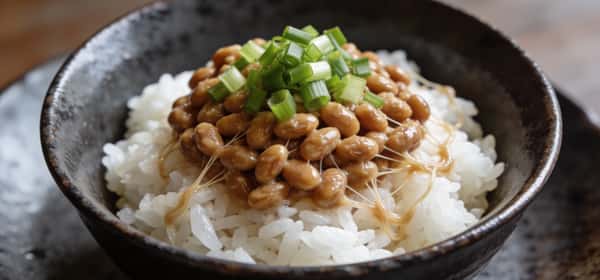
Natto is made by fermenting soybeans with a specific bacterium, Bacillus subtilis. That fermentation produces natto’s signature sticky, stringy coating and its strong, savory-funky flavor — and, more importantly, transforms the humble soybean into a food with a nutrient profile unlike almost anything else.
Choose your goal and get a meal plan full of foods you actually like.
Powered by DietGenie Eat healthy
 Lose weight
 Gain muscles
 Explore new cuisines
Like miso and tempeh, natto is a fermented soy food, but it’s fermented differently, which is why it delivers compounds the others don’t.
Vitamin K2: natto’s headline benefit
Natto is, by a wide margin, the best food source of vitamin K2 — specifically the MK-7 form, which stays active in the body longer and is well absorbed. Vitamin K2 plays a key role in directing calcium to where it belongs (your bones) and away from where it doesn’t (your arteries).
The research is encouraging, if still developing. In a randomized controlled trial, MK-7 (the same form abundant in natto) slowed the progression of arterial stiffness in patients on hemodialysis — a group especially prone to vitamin K deficiency and stiffening arteries — with the clearest benefit in those with diabetes.1 More broadly, adequate vitamin K2 is tied to better bone and cardiovascular health. Our dedicated vitamin K2 guide covers the mechanisms in depth — and natto is the easiest way to get a large dose from food.
Nattokinase and heart health
Fermentation also produces nattokinase, an enzyme unique to natto that has drawn interest for cardiovascular health. A systematic review and meta-analysis of randomized controlled trials found that nattokinase supplementation significantly reduced both systolic and diastolic blood pressure compared with placebo, with no notable adverse events.2
A caveat worth stating plainly: most of that trial evidence uses concentrated nattokinase supplements, not measured amounts of natto itself, so the food’s effect is likely gentler. Still, it points to a genuine mechanism and adds to natto’s cardiovascular case rather than resting the whole thing on it.
The soy and gut benefits
On top of its signature compounds, natto is a whole fermented soy food, which means it also carries the general benefits of both.
Soy: A meta-analysis of randomized trials found soy foods lower LDL and total cholesterol and modestly raise HDL, with whole soy foods outperforming isolated supplements.3 Natto delivers complete plant protein and soy isoflavones in a whole-food package.
Gut: As a fermented food, natto fits the category most consistently tied to gut health. A Stanford trial found that eating more fermented foods raised gut microbiome diversity and lowered inflammatory markers.4 Natto also brings fiber, which feeds beneficial bacteria — pair it with other prebiotic foods and see our ways to improve gut bacteria guide.
Nutrition at a glance
Natto is genuinely nutrient-dense. A serving provides:
- Complete plant protein
- The highest food levels of vitamin K2 (MK-7) you can find
- Fiber for digestion and gut bacteria
- Iron, manganese, copper, and magnesium
- Probiotic bacteria and the enzyme nattokinase
- Soy isoflavones and other anti-inflammatory compounds
Few foods pack this combination into so few calories.
The important caveat: blood thinners
This one matters. Because natto is so extraordinarily high in vitamin K, it can interfere with warfarin and other vitamin-K-antagonist blood thinners, which work precisely by blocking vitamin K. Natto can blunt the medication and is generally considered off-limits for people taking it. If you’re on any blood-thinning medication, talk to your doctor before eating natto — and when in doubt, avoid it.
For everyone else, natto is safe and, for most, an acquired taste. The other “caveat” is simply the smell, texture, and strong flavor, which take some getting used to.
How to eat natto
- Serve it the traditional way: over rice with a little soy sauce, mustard (karashi), and chopped scallion, which balances the strong flavor.
- Stir it well. Whisking natto develops the sticky strands and mellows the taste for newcomers.
- Don’t overheat it. As with other live-culture foods, high heat undercuts the beneficial bacteria and enzymes — natto is traditionally eaten warm-not-cooked, over hot rice.
- Start small. A few tablespoons is a serving; ease in if the flavor is new to you.
- Buy it frozen or refrigerated from Asian grocers, and thaw in the fridge.
Suggested read: Vitamin K2: Everything You Need to Know About Benefits & Sources
The bottom line
Natto earns its superfood reputation more than most. It’s the single best food source of vitamin K2 (MK-7) — linked to bone and cardiovascular health — and it uniquely contains nattokinase, which trials tie to lower blood pressure. Layer on the cholesterol benefits of whole soy and the gut benefits of fermentation, and few foods offer this much in one sticky spoonful.
The non-negotiable caveat is blood thinners: if you take warfarin, natto’s sky-high vitamin K makes it a food to avoid. For everyone else, the only real hurdle is the acquired taste. Push past it and natto is one of the most nutrient-dense fermented foods you can eat. Dig into the details in our vitamin K2 guide, compare its fermented-soy cousins in miso and tempeh, or see the full fermented foods roundup.
Naiyarakseree N, Phannajit J, Naiyarakseree W, et al. Effect of Menaquinone-7 Supplementation on Arterial Stiffness in Chronic Hemodialysis Patients: A Multicenter Randomized Controlled Trial. Nutrients. 2023;15(11):2422. PubMed ↩︎
Li X, Long J, Gao Q, et al. Nattokinase Supplementation and Cardiovascular Risk Factors: A Systematic Review and Meta-Analysis of Randomized Controlled Trials. Rev Cardiovasc Med. 2023;24(8):234. PubMed ↩︎
Tokede OA, Onabanjo TA, Yansane A, Gaziano JM, Djoussé L. Soya products and serum lipids: a meta-analysis of randomised controlled trials. Br J Nutr. 2015;114(6):831-843. PubMed ↩︎
Wastyk HC, Fragiadakis GK, Perelman D, et al. Gut-microbiota-targeted diets modulate human immune status. Cell. 2021;184(16):4137-4153.e14. PubMed ↩︎