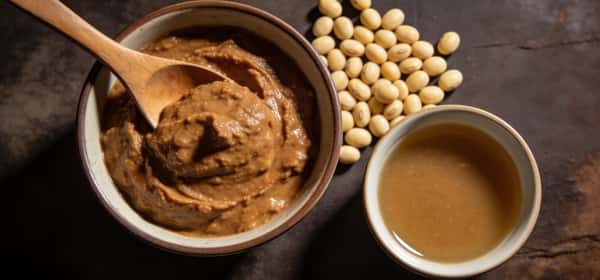
Miso — the salty, savory, umami-rich paste behind miso soup — is a cornerstone of Japanese cooking and a genuine fermented food with real health credentials. It’s made by fermenting soybeans, so it combines the benefits of whole soy with those of fermentation. But it’s also one of the saltiest foods in the pantry, which changes how you should use it. Here’s an honest breakdown of miso benefits and the caveat that matters.
Quick answer: Miso is a whole fermented soy food, which gives it a double advantage: gut-friendly cultures from fermentation and heart-supportive compounds from soy. Research links whole soy foods to better cholesterol, and fermented foods to a healthier, more diverse gut. The big caveat is sodium — miso is very salty, so use it as a flavorful seasoning, not something to eat in large volumes. For the wider context, see our fermented foods guide.
What miso is
Miso is made by fermenting soybeans with salt and a mold culture called koji (Aspergillus oryzae), often together with rice or barley. The mixture ages for anywhere from a few weeks to several years, developing its deep, savory flavor. Lighter, shorter-fermented miso is milder and sweeter; darker, longer-fermented miso is saltier and more intense.
Choose your goal and get a meal plan full of foods you actually like.
Powered by DietGenie Eat healthy
 Lose weight
 Gain muscles
 Explore new cuisines
Because it’s built on soybeans, miso sits in the same family as other fermented soy foods like tempeh and natto — each fermented differently, each with its own profile.
The main types of miso
Not all miso is the same, and the type affects both flavor and salt content:
- White miso (shiro) is fermented for a short time, often with a higher proportion of rice. It’s the mildest, sweetest, and lowest in salt — a good starting point and great for dressings and light soups.
- Red miso (aka) ferments longer, giving it a darker color, deeper savory punch, and higher salt content. Best for hearty soups, braises, and glazes.
- Mixed / yellow miso (awase) sits in between and is the versatile all-rounder most recipes call for.
If sodium is a concern, reach for white miso and use it sparingly — you’ll get the flavor and the fermentation benefits with less salt.
The soy benefit
Soybeans are one of the few plant foods that provide complete protein, and they’re rich in isoflavones, plant compounds studied for their effects on heart health. A meta-analysis of randomized controlled trials found that consuming soy products significantly lowered LDL (“bad”) cholesterol, total cholesterol, and triglycerides, while modestly raising HDL (“good”) cholesterol — and notably, whole soy foods worked better than isolated isoflavone supplements.1 Miso, as a whole fermented soy food, fits squarely in that beneficial category.
Fermentation adds a bonus: it partially breaks down the soybeans, which can make some of their nutrients and protein easier to digest and absorb than in unfermented soy.

The gut benefit
Unpasteurized miso contains live cultures, and even beyond the live microbes, miso is a fermented food — the category most consistently linked to gut health. A Stanford trial found that eating more fermented foods over 17 weeks increased gut microbiome diversity and reduced markers of inflammation, a meaningful result given how central microbial diversity is to gut health.2
There’s a practical catch, though: miso is usually stirred into hot liquid, and boiling kills the live cultures. To keep them, add miso off the heat (more on that below). Even pasteurized or cooked miso still delivers soy compounds and flavor — you just lose the live-probiotic angle. To support your gut more broadly, pair miso-based meals with prebiotic foods and see our ways to improve gut bacteria guide.
Nutrition at a glance
A tablespoon of miso is small but mighty, contributing:
- Plant protein and all nine essential amino acids
- B vitamins, including some produced during fermentation
- Minerals like manganese, copper, and zinc
- Vitamin K
- Antioxidant compounds that support its anti-inflammatory potential
The amounts per serving are modest because you eat miso in small quantities — which is exactly how it should be used.
The sodium caveat — this one is important
Miso is extremely salty. A single tablespoon can contain a large share of a day’s sodium, and miso soup made with several servings adds up fast.
This isn’t a minor footnote. A large Japanese cohort study found that people who drank three or more bowls of miso soup a day had roughly 60% higher risk of gastric (stomach) cancer, tracking with high overall sodium intake.3 The lesson isn’t to avoid miso — it’s to respect the portion. Used as a seasoning (a spoonful to flavor a soup, dressing, or marinade), miso is a healthy addition. Drunk in large volumes daily, the sodium load becomes the dominant factor. If you’re watching blood pressure, treat miso as the salty ingredient it is and count it toward your daily sodium.
How to use miso for maximum benefit
- Add it off the heat. Dissolve miso into soup or broth after you take it off the burner (below a simmer) to preserve the live cultures and its delicate flavor.
- Use unpasteurized miso from the refrigerated section if live probiotics matter to you.
- Keep portions to a seasoning. A spoonful goes a long way — you’re after flavor, not volume.
- Look beyond soup. Miso makes excellent salad dressings, marinades for fish and vegetables, and glazes — often with less total salt than a big bowl of soup.
- Balance the salt by keeping the rest of the meal low in sodium.
Suggested read: Natto Benefits: Vitamin K2, Nattokinase & Heart Health
The bottom line
Miso is a genuinely healthy food used the way it’s meant to be used: as a savory seasoning rather than a beverage. As a whole fermented soy food, it brings together the cholesterol-friendly compounds of soy — backed by meta-analysis evidence — and the gut benefits of fermentation, which raises microbial diversity and lowers inflammation.
The single thing to keep front of mind is sodium: miso is one of the saltiest things in the kitchen, so a spoonful to flavor a dish is smart, while several bowls of miso soup a day is not. Add it off the heat, keep portions small, and miso earns its place as one of the tastier evidence-backed fermented foods. Explore its fermented-soy cousins in our natto and tempeh guides, or the full fermented foods roundup.
Tokede OA, Onabanjo TA, Yansane A, Gaziano JM, Djoussé L. Soya products and serum lipids: a meta-analysis of randomised controlled trials. Br J Nutr. 2015;114(6):831-843. PubMed ↩︎
Wastyk HC, Fragiadakis GK, Perelman D, et al. Gut-microbiota-targeted diets modulate human immune status. Cell. 2021;184(16):4137-4153.e14. PubMed ↩︎
Umesawa M, Iso H, Fujino Y, Kikuchi S, Tamakoshi A. Salty Food Preference and Intake and Risk of Gastric Cancer: The JACC Study. J Epidemiol. 2016;26(2):92-97. PubMed ↩︎