You probably noticed it in a photo first — a little more forehead than you remembered, or a thin spot at the crown catching the light. Male pattern baldness is the most common reason men lose hair, and it affects a striking share of guys by middle age. The frustrating part is how slow and sneaky it is. By the time it’s obvious in the mirror, the process has usually been running quietly for years.
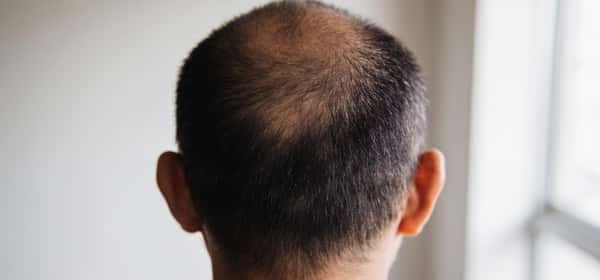
Here’s the good news: you understand far more about what’s happening than men did even a decade ago, and there are treatments that genuinely work — if you start early enough. This guide walks through what male pattern baldness actually is, how it progresses, and what your real options are.
Quick answer: Male pattern baldness (androgenetic alopecia) is a genetic, hormone-driven condition where a byproduct of testosterone called DHT gradually shrinks sensitive hair follicles until they stop producing visible hair. It follows a predictable pattern — a receding hairline and thinning crown — and tends to get worse over time without treatment. The two treatments with the strongest evidence are minoxidil and finasteride. Neither cures baldness, but both can slow the loss and partially regrow hair, and they work best the earlier you begin. Nutrition and supplements play a supporting role but won’t reverse genuine pattern hair loss on their own.
Glow starts with what you eat. Choose your goal and get your plan.
Powered by DietGenie Eat healthy
 Lose weight
 Gain muscles
 Explore new cuisines
What male pattern baldness actually is
The medical name is androgenetic alopecia, and that mouthful tells you the two main ingredients: androgens (male hormones) and genetics. Both have to be in play.
The hormone at the center of it is dihydrotestosterone, or DHT. Your body converts a portion of testosterone into DHT using an enzyme called 5-alpha-reductase. DHT is a normal, useful hormone — but in men who are genetically sensitive to it, DHT binds to receptors in certain scalp follicles and triggers a process called miniaturization.1
Miniaturization is the heart of the whole thing. Each affected follicle doesn’t die overnight. Instead, with every growth cycle, it shrinks a little. The hairs it produces get progressively shorter, finer, and lighter — going from thick, pigmented “terminal” hairs to wispy, barely-there “vellus” hairs, the kind that cover a baby’s body. Eventually the follicle’s growth phase becomes so short that the hair never reaches the surface. The follicle is still alive, but functionally it’s gone quiet.
Two things make this specifically pattern baldness:

- Not all follicles are sensitive. The hair around the sides and back of your head is largely resistant to DHT, which is why even very bald men keep that horseshoe ring. (It’s also why those hairs can be transplanted to the top and keep growing.)
- It’s genetic. If your father, grandfathers, or uncles went bald, your odds go up. The inheritance is complex and comes from both sides of the family, so the old myth that you only get it from your mother’s father is just that — a myth.
Why it happens when it happens
Male pattern baldness isn’t a disease that “strikes.” It’s more like a clock that was set before you were born and runs on hormones.
Testosterone and DHT levels climb during and after puberty, which is why pattern hair loss can start surprisingly young — some men notice a receding hairline in their late teens or early twenties. Importantly, balding men usually don’t have abnormally high testosterone. The issue is follicle sensitivity to normal hormone levels, not an excess of hormones. That’s a common misunderstanding worth correcting: going bald says nothing bad about your testosterone, your virility, or your health.
Age is the other factor. The longer your sensitive follicles are exposed to DHT, the more miniaturization accumulates. That’s why pattern baldness is partly a numbers game — give it enough years and the affected area widens.
Suggested read: Postpartum Hair Loss: Causes, Timeline, and What Helps
The stages of male pattern baldness
Dermatologists often describe progression using the Norwood scale, which runs from a full head of hair to extensive baldness. You don’t need the clinical version to recognize the broad arc:
| Stage | What you’d notice |
|---|---|
| Early | The hairline starts to recede at the temples, forming a more defined “M” shape. Often the first sign. |
| Developing | The crown (the spot at the back top of your head) begins to thin independently. You might not see it without a second mirror. |
| Advancing | The receding front and the thinning crown grow toward each other, leaving a thinning bridge between them. |
| Advanced | The bridge gives way, merging the bald areas, leaving hair mainly along the sides and back. |
Two patterns dominate: temple/hairline recession from the front, and a thinning circle at the crown. Many men get both at once. The pace varies enormously — some men recede a little in their twenties and then stay roughly stable for years, while others move through the stages steadily.
The practical takeaway from the staging is simple: the earlier the stage when you start treatment, the more hair you have to protect. Treatments are far better at keeping the hair you’ve got than at resurrecting follicles that have already gone fully dormant.
How it’s diagnosed
Most of the time, the diagnosis is visual — the pattern is distinctive enough that a dermatologist can recognize it on sight. A few features help separate pattern baldness from other causes of hair loss:
- It’s gradual, playing out over years, not weeks.
- It follows the classic pattern (hairline and crown), rather than thinning evenly all over or falling out in patches.
- It’s non-scarring — the scalp looks normal, with no redness, scaling, or smooth shiny bald spots.
If your hair loss looks different — sudden diffuse shedding, round bald patches, an itchy or inflamed scalp, or loss that came on fast — that points to something else, like telogen effluvium from stress or weight change, alopecia areata, or a scalp condition. Those have different causes and treatments, so it’s worth getting an accurate diagnosis rather than assuming everything is “just genetics.” Blood tests for iron, thyroid, and vitamin D are sometimes useful to rule out contributors.
Suggested read: Spearmint Tea for PCOS: Dose, Evidence, and Timeline
What actually helps
This is where the news gets better. You can’t change your genes, but you can interfere with the DHT process and support the follicles you still have. Here are the options ranked roughly by strength of evidence.
Minoxidil (topical or low-dose oral)
Minoxidil doesn’t touch DHT. Instead, it extends the growth phase of the hair cycle and improves blood flow to the follicle, nudging miniaturizing hairs back toward thicker growth. In men, 5% topical minoxidil clearly beats placebo and the lower 2% strength for regrowth.2 Low-dose oral minoxidil has become a popular prescription alternative for men who find the liquid messy or irritating.3 It’s available over the counter (topical) and is usually the first thing people try. Our full minoxidil guide covers how to use it and what to expect.
Finasteride
Finasteride attacks the root cause. It blocks the 5-alpha-reductase enzyme, lowering scalp DHT and slowing or halting miniaturization. It’s a prescription pill with strong evidence for keeping and partially regrowing hair, especially at the crown. It also carries a small risk of sexual side effects that matter to some men, so it’s a genuine personal trade-off — weigh it in our finasteride benefits and risks breakdown. A related drug, dutasteride, blocks DHT even more strongly and is sometimes used off-label.4
Combining the two
Minoxidil and finasteride work through completely different mechanisms, so using both together generally outperforms either alone. Many dermatologists consider the combination the most effective non-surgical approach for men who want to be aggressive about keeping their hair.5
Procedures
For men who want regrowth in areas that are already bare, hair transplantation moves DHT-resistant follicles from the back and sides to the thinning top, and those grafts keep growing. Platelet-rich plasma (PRP) injections and low-level laser devices have more modest, mixed evidence but are used as add-ons.5
Nutrition and supplements
Diet won’t reverse pattern baldness, but deficiencies in iron, zinc, protein, or vitamin D can worsen shedding and undermine your other treatments. Covering the basics gives your follicles the raw materials to do their job. See our guides on the best vitamins for hair growth and hair growth supplements for what has evidence and what’s hype.
Suggested read: Female Pattern Hair Loss: Causes, Signs, Treatments
Setting realistic expectations
A few honest points that save a lot of frustration:
- Treatments maintain better than they regrow. Your best outcome is usually keeping what you have plus a modest thickening, not a teenage hairline.
- They require commitment. Minoxidil and finasteride only work while you use them. Stop, and the hair you saved will gradually shed over the following months as DHT resumes its work.
- Patience is mandatory. Hair grows slowly. Give any treatment at least four to six months, and ideally a year, before judging it. Many men even shed a little extra in the first weeks as old hairs make way for new growth.
- Earlier beats later, every time. The single biggest lever you control is when you start.
The bottom line
Male pattern baldness is a normal, genetic, hormone-driven process — not a sign that anything is wrong with you. It comes from DHT gradually miniaturizing genetically sensitive follicles, and it follows a predictable pattern of hairline recession and crown thinning that tends to advance with age.
You can’t cure it, but you’re far from powerless. Minoxidil and finasteride both have solid evidence, work even better together, and shine brightest when started early. Supplements and good nutrition support the effort but don’t replace it. The most useful thing you can do today is decide how much keeping your hair matters to you, and if it does, act sooner rather than later — because every follicle you protect now is one you don’t have to chase back later.
Owecka B, Tomaszewska A, Dobrzeniecki K, Owecki M. The Hormonal Background of Hair Loss in Non-Scarring Alopecias. Biomedicines. 2024;12(3):513. PubMed ↩︎
Olsen EA, Dunlap FE, Funicella T, et al. A randomized clinical trial of 5% topical minoxidil versus 2% topical minoxidil and placebo in the treatment of androgenetic alopecia in men. J Am Acad Dermatol. 2002;47(3):377-385. PubMed ↩︎
Randolph M, Tosti A. Oral minoxidil treatment for hair loss: A review of efficacy and safety. J Am Acad Dermatol. 2021;84(3):737-746. PubMed ↩︎
Arif T, Dorjay K, Adil M, Sami M. Dutasteride in Androgenetic Alopecia: An Update. Curr Clin Pharmacol. 2017;12(1):31-35. PubMed ↩︎
Rosenthal A, Conde G, Greco JF, Gharavi NM. Management of androgenic alopecia: a systematic review of the literature. J Cosmet Laser Ther. 2024;26(1-4):1-16. PubMed ↩︎ ↩︎