The word “grains” makes people picture something like rice or wheat — but kefir grains are nothing of the sort. They’re squishy, living clusters that look a bit like tiny cauliflower florets, and they’re the engine that turns ordinary milk into probiotic-rich kefir. If you want to make your own kefir (and get the most diverse probiotics out of it), understanding these curious little cultures is the key. Here’s what kefir grains actually are, how they work, and how to keep them thriving.
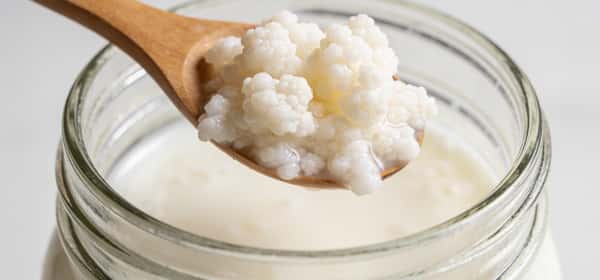
Quick answer: Kefir grains aren’t cereal grains — they’re a living symbiotic culture of bacteria and yeasts bound together in a matrix of a compound called kefiran (a type of exopolysaccharide). Added to milk, they ferment it into kefir by consuming the milk sugars, and in the process they multiply and grow. You strain them out, reuse them for the next batch, and with basic care they can keep making kefir indefinitely. They’re what gives kefir its uniquely diverse probiotic profile. For the drink itself, see our kefir benefits guide.
What kefir grains actually are
Despite the name, there’s no grain, gluten, or cereal involved. A kefir grain is a small, gelatinous, off-white cluster — soft and rubbery, ranging from the size of a grain of rice to a walnut.
Choose your goal and get a meal plan full of foods you actually like.
Powered by DietGenie Eat healthy
 Lose weight
 Gain muscles
 Explore new cuisines
Structurally, each grain is a symbiotic community of many species of bacteria and yeasts living together, all held in a matrix made largely of kefiran, an exopolysaccharide (a gel-like sugar compound) produced by the culture itself.1 This living matrix is what distinguishes kefir from yogurt: instead of a couple of bacterial strains, you get a whole miniature ecosystem — a dozen or more microbes working in concert. That diversity is the source of kefir’s rich probiotic reputation.
How they make kefir
The process is elegantly simple, which is part of kefir’s appeal. When you drop kefir grains into milk:
- The microbes feed on the milk’s natural sugar (lactose) and other nutrients.
- They ferment it, producing lactic acid (which thickens and sours the milk), plus small amounts of carbon dioxide and ethanol that give kefir its slight fizz and tang.2
- After about a day at room temperature, the milk has transformed into kefir.
- You strain out the grains and keep them for the next batch — the grains themselves aren’t eaten (though it’s harmless if a bit slips through).
The leftover grains are then ready to ferment a fresh batch of milk, over and over.
They grow and multiply
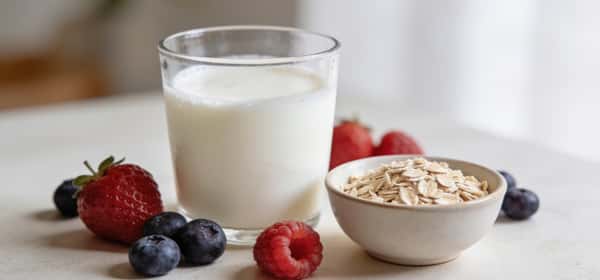
One of the most satisfying things about kefir grains is that they’re alive and self-propagating. As they ferment batch after batch, they grow and multiply, so your collection slowly expands. That means:
- You never need to buy them again once you have a healthy set — they keep going indefinitely with care.
- You’ll end up with extra, which you can share with friends, use to make bigger batches, or (for milk kefir grains) blend into smoothies.
- They’re essentially free kefir forever after the initial acquisition, which is a big part of why homemade kefir is so economical.
This living, renewable quality is what makes kefir grains feel less like an ingredient and more like a low-maintenance pet.
How to care for kefir grains
Keeping grains healthy is straightforward:
- Feed them regularly. Grains need fresh milk (for milk kefir grains) to stay alive. Strain and re-milk them every day or two at room temperature.
- Use non-metal tools. Prolonged contact with reactive metals can harm the culture — use plastic or wooden strainers and spoons, and glass jars.
- Don’t seal them airtight during fermentation. The yeasts produce a little CO2, so a breathable cover (cloth) or loosely closed lid is best.
- Take a break in the fridge. Going away? Store the grains in fresh milk in the fridge to slow them down; they can pause for a couple of weeks.
- Rinse rarely. You generally don’t need to rinse grains between batches (and rinsing in chlorinated tap water can stress them). Just strain and re-milk.
Healthy grains look plump and off-white and produce good kefir on schedule; if they turn slimy, discolored, or stop working, something’s off.
Milk vs water kefir grains
Worth knowing: milk kefir grains and water kefir grains are different cultures and aren’t interchangeable. Milk kefir grains ferment dairy; water kefir grains (tibicos) ferment sugar water and are translucent and crystal-like rather than cauliflower-like. Each needs its own food source — put milk grains in sugar water (or vice versa) and they’ll starve. We compare the two drinks in water kefir vs milk kefir.
Where to get kefir grains
You have a few options:
- From a friend who makes kefir — since grains multiply, kefir makers often have extras to give away. This is the traditional (and free) route.
- Online or specialty stores sell live kefir grains, sometimes dehydrated (which you rehydrate before use).
- Not the same as powdered starters. Some products are freeze-dried “kefir starter cultures” rather than real grains — convenient, but they don’t multiply and reuse the way true grains do, and may be less diverse.
For the richest, most diverse probiotics, live grains that you maintain yourself are the gold standard — and homemade kefir tends to be more microbially diverse than commercial versions.1
Suggested read: How to Make Kefir at Home: Simple Step-by-Step Guide
The bottom line
Kefir grains are the living heart of kefir — not cereal grains at all, but soft, cauliflower-like clusters of bacteria and yeasts bound in a kefiran matrix. Drop them in milk and they ferment it into tangy, probiotic-rich kefir, then you strain them out and reuse them again and again. Because they multiply as they work, a single healthy set becomes a renewable, essentially free supply of kefir for life.
Care for them simply — regular fresh milk, non-metal tools, a breathable cover, and a fridge pause when needed — and they’ll keep producing indefinitely. Their symbiotic diversity is exactly what gives kefir its edge over yogurt on probiotics. If you’re ready to put them to work, head to how to make kefir for the step-by-step.
One last reassurance for beginners: kefir grains are hardy and forgiving. New grains sometimes take a few batches to hit their stride, and they’ll happily pause in the fridge when life gets busy. Treat them with the basics — fresh milk, no harsh metal or chlorine, a breathable cover — and they’re one of the most low-maintenance, rewarding cultures you can keep, quietly turning cheap milk into a premium probiotic drink day after day.
Vieira CP, Rosario AILS, Lelis CA, et al. Bioactive Compounds from Kefir and Their Potential Benefits on Health: A Systematic Review and Meta-Analysis. Oxid Med Cell Longev. 2021;2021:9081738. PubMed ↩︎ ↩︎
Farag MA, Jomaa SA, El-Wahed AA, El-Seedi HR. The Many Faces of Kefir Fermented Dairy Products: Quality Characteristics, Flavour Chemistry, Nutritional Value, Health Benefits, and Safety. Nutrients. 2020;12(2):346. PubMed ↩︎