That dried-out, slightly headachey feeling after a long flight isn’t just in your head. Airplane cabins are some of the driest environments your body regularly sits in, and a few hours up there quietly pulls water out of you. Getting hydration on planes right is simple once you know the targets — and it ties directly into a more serious issue on long flights: keeping your blood moving so it doesn’t pool and clot in your legs. Here’s the practical version.
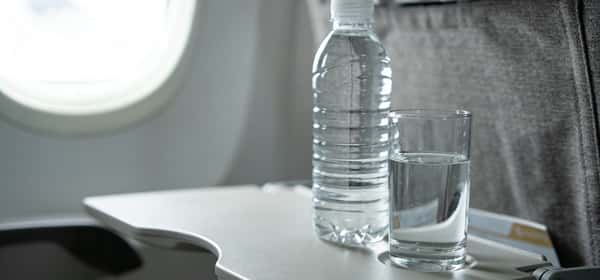
Quick answer
- Cabin humidity often drops below 20%, well under the 40–60% you’d have at home, so you lose water faster through breath and skin.1
- Sip steadily — roughly 200–250 ml of water per waking hour is a sensible target on a long flight.
- Alcohol is the real problem, not caffeine. Alcohol dehydrates and ruins sleep; moderate caffeine is fine.
- Move your calves every 1–2 hours to lower clot risk; seek care for one-sided calf pain or swelling after a flight.
Why plane air dries you out
At cruising altitude the outside air is extremely cold and holds almost no moisture. The cabin is pressurized with a large share of that very dry outside air, so humidity inside settles low — frequently under 20%, compared with the 40–60% range of a typical home.1 Your body keeps losing water the way it always does, through breathing and through your skin, but there’s far less moisture in the air to slow that loss. Over a multi-hour flight it adds up to a noticeable deficit, which shows up as a dry mouth, dry eyes, tight skin, and sometimes a headache.
This dryness isn’t dangerous on its own, but pairing it with travel-day alcohol and skipped water turns mild into genuinely uncomfortable — and dehydration is one of the factors that can thicken blood and contribute to clot risk on long flights.2
Regular, balanced meals keep your energy up. Choose your goal and get your plan.
Powered by DietGenie Eat healthy
 Lose weight
 Gain muscles
 Explore new cuisines
How much to actually drink
You don’t need to force liters. The goal is steady replacement, not a flood.
| Flight length | Rough water target | How |
|---|---|---|
| Short (< 2 h) | A cup or two | Fill up after security |
| Medium (2–5 h) | ~200–250 ml per waking hour | Refillable bottle + cabin service |
| Long-haul (5+ h) | Same per-hour rate, sustained | Bottle, plus ask for water on rounds |
Practical tips:
- Bring an empty bottle through security and fill it at a fountain after — it saves you rationing tiny plastic cups.
- Sip on a schedule, not just when service comes around.
- Watch your urine color — pale straw is the target; dark yellow means catch up.
For the everyday basics behind all this, see the health benefits of water.

Do you need electrolytes?
For a typical flight, plain water is enough. You’re losing water, not sweating buckets, so you don’t need a sports drink at 35,000 feet. Electrolytes start to matter when you’re also losing a lot through sweat — a long flight into a hot, humid destination followed by activity, for instance, or if you arrive already depleted. In those cases, adding sodium and other minerals helps you actually hold onto the fluid you drink. Our guides on electrolytes and electrolyte drinks cover when they’re worth it and when they’re just sugar water.
Alcohol and caffeine, sorted out
This is where travelers get the most confused.
Alcohol is the one to limit. It’s a diuretic, so it adds to your fluid deficit, and it badly fragments the sleep you might otherwise get on an overnight flight — a double hit when you’re trying to arrive functional. A pre-flight drink to take the edge off is fine; steady drinking across a long-haul is not.
Caffeine is less of a villain than its reputation. Moderate caffeine has only a mild diuretic effect, and habitual coffee or tea drinkers largely adapt to it, so your morning coffee isn’t sabotaging your hydration. The full evidence is in does coffee dehydrate you. The catch is timing: caffeine late in a flight can wreck your ability to sleep and adjust to a new time zone, which matters for jet lag more than for hydration.
Suggested read: Immunity for Travel: What Actually Protects You
Moving your blood: the DVT angle
Here’s the part that’s about more than comfort. Sitting still for hours slows the blood flow in your legs, and on long flights that can let a clot form in a deep vein — deep vein thrombosis (DVT). The absolute risk for a healthy person is low, but it rises with flight duration and with personal risk factors, and dehydration and immobility both feed into it.2
The good news is that prevention is mostly free and simple:
- Pump your calves every 1–2 hours — calf raises, ankle circles, and pressing your toes into the floor. The calf muscles act as a pump that pushes blood back up your legs.
- Walk the aisle every couple of hours on long flights.
- Stay hydrated — it helps keep blood from thickening.2
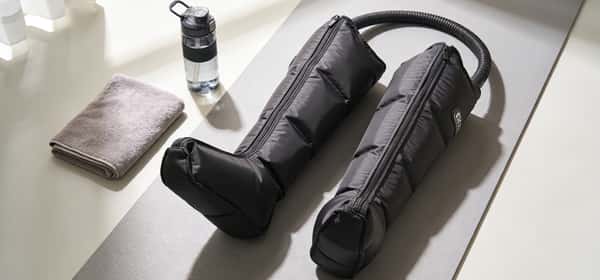
- Wear graduated compression stockings if you’re higher risk. In one controlled study, below-knee stockings cut DVT incidence dramatically in higher-risk long-haul passengers.3
- Avoid crossing your legs for long stretches and don’t wedge a bag under the seat so tightly you can’t move your feet.
Higher-risk travelers include those with a previous clot, recent surgery, active cancer, pregnancy, obesity, or certain hormone treatments — if that’s you, talk to your doctor before a long flight.
Red flag — act on this: pain, tenderness, swelling, warmth, or redness in one calf or leg during or after a flight is the classic sign of a clot. Sudden chest pain or breathlessness can mean a clot has traveled to the lungs. Either one is a medical emergency — seek care immediately, don’t wait it out.
Signs you’re falling behind
You don’t need to track milliliters obsessively — your body gives clear signals. Catch these early and top up:
- Dark yellow urine or going noticeably less often than usual
- Dry mouth, lips, or eyes beyond the usual cabin dryness
- Headache that creeps in mid-flight
- Feeling unusually tired or foggy when you land
A dull post-flight headache and that wrung-out feeling are often plain dehydration rather than “just travel.” Drinking steadily through the flight, rather than trying to rehydrate after you land, prevents most of it.
Suggested read: Exercising in Heat: How to Train Safely When Hot
After you land
Hydration doesn’t end at the gate. Arrival, especially in a hot or humid climate, is when an under-hydrated body really feels it. Have water within reach as you clear immigration and collect bags, and keep sipping through the first few hours. If you’ve flown into heat and you’re heading straight into activity, that’s the moment electrolytes can pull their weight — see electrolyte drinks. And resist the urge to celebrate arrival with several drinks on top of a dehydrating flight; your sleep and your adjustment to local time will both thank you. Resetting your body clock quickly is the other half of arriving well — our jet lag remedies guide covers that side.
Bottom line
Cabin air is genuinely dry — humidity under 20% pulls water out of you faster than you’d expect — so sip water steadily, roughly a small cup an hour on a long flight, and judge by urine color. Plain water is enough for most flights; save electrolytes for hot destinations or heavy sweating. Go easy on alcohol (the real dehydrator) more than caffeine (mostly fine in moderation). And don’t just sit there: work your calves every 1–2 hours, walk the aisle, and treat one-sided calf pain or swelling as a reason to get checked. For the full travel-wellness picture, see our travel health tips guide.
Greenleaf JE, Rehrer NJ, Mohler SR, Quach DT, Evans DG. Airline chair-rest deconditioning: induction of immobilisation thromboemboli? Sports Med. 2004;34(11):705-25. PubMed | DOI ↩︎ ↩︎
Marques MA, Panico MDB, Porto CLL, Milhomens ALM, Vieira JM. Venous thromboembolism prophylaxis on flights. J Vasc Bras. 2018;17(3):215-219. PubMed | DOI ↩︎ ↩︎ ↩︎
Belcaro G, Geroulakos G, Nicolaides AN, Myers KA, Winford M. Venous thromboembolism from air travel: the LONFLIT study. Angiology. 2001;52(6):369-74. PubMed | DOI ↩︎