Tight hip flexors are one of the most common postural problems in modern life. Sitting all day shortens them. They pull on the pelvis, contributing to lower back pain, anterior pelvic tilt, and reduced athletic performance. The fix is dynamic and static stretching, done consistently — not occasionally.
A 2025 randomized controlled trial in 40 male professional football players with chronic low back pain found that 8 weeks of dynamic hip flexor stretching (5x per week) produced significant improvements in:1
- Hip range of motion (large effect size, p ≤ 0.001)
- Pain reduction (effect size 0.85, p ≤ 0.001)
- Dynamic balance
- Countermovement jump performance
A 4-week detraining period showed partial loss of those gains — confirming that stretching effects require ongoing practice.
Choose your goal and get a meal plan that considers your joints.
Powered by DietGenie Eat healthy
 Lose weight
 Gain muscles
 Explore new cuisines
Here are 7 evidence-based hip flexor stretches that address the most common tightness patterns, plus how to actually integrate them into your routine.
For broader content, see anterior pelvic tilt and our stretching workout app for guided routines.
Why hip flexors get tight
The hip flexors are a group of muscles that lift your knee toward your chest:
- Iliopsoas (psoas major + iliacus) — the deepest, most often tight
- Rectus femoris — runs from hip to knee (also a quadriceps muscle)
- Sartorius — long thin muscle crossing the hip
- Tensor fasciae latae (TFL) — small but influential
Sitting positions these muscles in their shortened state for hours. Over weeks and years, the tissue adapts to that length — meaning the resting length of the muscle becomes shorter than it should be. When you stand up and try to extend your hip, those tight muscles pull on the pelvis, tilt it forward, and arch your lower back.
Common contributors:
- Office work / 8+ hours sitting daily
- Cycling (similar position to sitting)
- Pelvic anterior tilt patterns
- Lots of running without balanced strength work
- Pregnancy (weight shifts forward)
- Sleeping in fetal position chronically
Symptoms of tight hip flexors include:
- Lower back pain when standing or walking long distances
- Tight feeling in front of hip and upper thigh
- Difficulty achieving full hip extension
- Compensatory excessive lower back arch
- Reduced glute activation
- Pain or pinching in front of hip during squats
How to stretch effectively
A few principles before the moves:
Hold each stretch 30–60 seconds
Shorter holds (under 30 seconds) don’t produce the same neural and tissue changes. Longer holds (90+ seconds) provide diminishing returns.
Frequency beats intensity
Daily stretching at moderate intensity beats once-weekly aggressive stretching. The 2025 trial used 5x per week.1
Tuck your tailbone
The biggest mistake: leaning forward into the stretch without engaging the glutes or tucking the tailbone. The tuck is what actually stretches the iliopsoas.
Squeeze the glute on the stretching side
This activates the antagonist (glute) and inhibits the hip flexor through reciprocal inhibition — making the stretch deeper.
Breathe
Holding your breath while stretching is counterproductive. Slow nasal breathing relaxes the muscle.
Warm up first
Cold muscles don’t stretch as well. 2–3 minutes of light movement (walking, easy bodyweight squats) before deep stretching.
7 hip flexor stretches
1. Kneeling hip flexor stretch (the foundation)
The most fundamental hip flexor stretch.
How to do it:
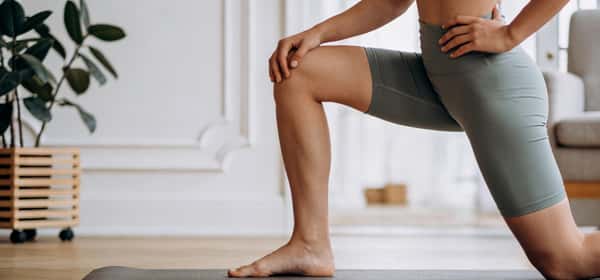
- Kneel on one knee with the other foot in front in a 90° lunge position
- Place a pad or folded towel under the kneeling knee
- Tuck your tailbone under (posterior pelvic tilt)
- Squeeze the glute of the kneeling-leg side
- Push your hips slightly forward — feel the stretch in the front of your hip
- Hold 30–60 seconds, repeat 2–3 times per side
Common mistakes:
- Leaning forward at the waist instead of tucking
- Not engaging the glute
- Letting the front knee drift past the toes
2. Couch stretch (deeper version)
A more aggressive hip flexor stretch when you’ve adapted to the kneeling version.
How to do it:
- Place one knee on the floor against a wall or the base of a couch
- The shin and foot of that leg point straight up against the wall
- Step the other foot forward into a deep lunge
- Tuck tailbone, squeeze the glute on the stretching-leg side
- Hold 30–90 seconds per side
This stretches both the iliopsoas and the rectus femoris (which also crosses the knee). More intense — start with kneeling stretch first.
Suggested read: 8 Simple Stretches to Relieve Lower Back Pain
3. Standing hip flexor stretch (no floor needed)
Useful at work, traveling, or when you can’t get on the ground.
How to do it:
- Stand in a long lunge position
- Front knee bent at 90°, back leg straight
- Tuck the tailbone under
- Squeeze the glute on the back leg side
- Push the hip forward slightly
- Hold 30–60 seconds per side
A great option for office breaks.
4. Lying psoas release (gentle, deep target)
Specifically targets the deep psoas muscle.
How to do it:
- Lie on your back near the edge of a bed or bench
- Hug one knee to your chest
- Let the other leg hang off the edge of the bed
- The hanging leg gradually drops into hip extension under gravity
- Relax and breathe; hold 1–2 minutes per side
This is a passive stretch — let gravity do the work. Best for chronic tightness.
5. Pigeon pose (yoga’s hip opener)
A classic yoga pose. Stretches multiple hip muscles including some flexors.
How to do it:
- From hands and knees, bring one knee forward toward the same-side wrist
- The shin of that leg crosses to the opposite hand (or angles based on flexibility)
- Slide the other leg straight back
- Lower your torso forward over the front leg
- Hold 1–2 minutes per side
Modify by placing pillows under the front hip if it doesn’t reach the floor.
6. World’s greatest stretch (compound mobility move)
A dynamic stretch that hits multiple muscle groups including hip flexors.
How to do it:
- Step into a deep lunge position
- Place both hands on the floor inside the front foot
- Drive the same-side elbow toward the floor inside the front foot
- Rotate the torso to point that arm toward the ceiling
- Repeat 5–8 times per side
Excellent dynamic warm-up before lifting or running.
Suggested read: Postpartum Exercise: Safe Return-to-Movement Guide
7. Wall-supported hip flexor stretch (for stability)
For people with balance challenges or post-injury.
How to do it:
- Stand facing a wall, about an arm’s length away
- Place hands on the wall at shoulder height for support
- Step one foot forward into a lunge, back leg straight
- Tuck tailbone, squeeze back-leg glute
- Hold 30–60 seconds per side
The wall provides stability; lets you focus on the stretch without worrying about falling.
Daily routine: 5-minute hip flexor reset
A practical routine you can do daily:
| Move | Time |
|---|---|
| Light warm-up (walk in place or air squats) | 1 min |
| Kneeling hip flexor stretch | 45 sec each side |
| Pigeon pose | 60 sec each side |
| Standing hip flexor stretch | 30 sec each side |
Total: ~5 minutes. Done daily, this addresses most tight hip flexor patterns within 4–8 weeks.
Strengthening to maintain the gains
Stretching alone doesn’t fix tight hip flexors permanently. The opposite muscles need to be strong enough to hold the corrected position:
Glute strengthening (key)
- Glute bridges — 3 sets of 12–15
- Hip thrusts — 3 sets of 8–12
- Single-leg deadlifts — 3 sets of 8 per side
Core strength (supporting)
- Dead bug — 3 sets of 8 per side
- Pallof press — 3 sets of 8 per side
- Side plank — 30–60 seconds each side
For more, see anterior pelvic tilt for the full corrective program.
How long until you see results
The 2025 RCT measured significant improvements in hip range of motion, pain, and function after 8 weeks of 5x-weekly stretching.1
Realistic timeline:
| Week | What you’ll likely notice |
|---|---|
| 1–2 | Stretches feel intense; small range of motion gains |
| 3–4 | Stretches feel less intense at the same depth; modest pain reduction |
| 5–8 | Substantial range of motion improvement; clearer pain reduction |
| 8+ | New baseline of mobility holds with continued practice |
| Stop for 4+ weeks | Most gains are lost — consistent practice is required |
The detraining loss in the 2025 study confirms what most clinicians see: stretching needs to be ongoing, not a 4-week intervention you check off.
Suggested read: Stretch Therapy: Benefits, Risks, and How It Works
When to see a professional
Consider physical therapy or sports medicine if:
- Hip flexor pain persists despite 6+ weeks of consistent stretching
- Pain is sharp or sudden rather than tightness
- Pain radiates down the leg
- You have hip clicking or catching
- You have a history of hip surgery or injury
- Pain prevents normal daily activities
Some apparent “hip flexor tightness” is actually:
- Hip impingement (FAI)
- Hip labral tear
- Femoral nerve entrapment
- Inguinal hernia
- Hip arthritis
A trained PT can distinguish.
Common mistakes
Stretching cold
Always do 2–3 minutes of light movement first.
Skipping the tailbone tuck
Without the tuck, you’re not stretching the deepest hip flexors.
Going too deep too fast
Work into the stretch gradually. Forcing range causes injury, not improvement.
Inconsistency
Stretching hip flexors once weekly produces nothing. Daily or near-daily is required.
Ignoring strength
Stretching tight muscles without strengthening their antagonists means the tightness returns.
Doing only one stretch
The hip flexor group has multiple muscles. Use a variety of stretches.
Who especially benefits
- Desk workers (8+ hours seated daily)
- Cyclists (sustained hip flexion in cycling position)
- Runners (especially with high mileage)
- People with anterior pelvic tilt
- People with chronic low back pain
- Athletes in sports requiring hip extension (sprinters, soccer players)
- Pregnant women (with appropriate modifications)
- Older adults with mobility limitations
Common questions
Should I stretch hip flexors before or after workouts? Dynamic stretches before; static stretches after or as a separate session. Aggressive static stretching immediately before lifting or sprinting can briefly reduce strength output.
How often should I stretch? For results: 5+ times per week (the 2025 RCT used this frequency).1 For maintenance: 3–4 times per week.
Will hip flexor stretches fix my lower back pain? Often help substantially, especially if the back pain is associated with anterior pelvic tilt. Won’t fix back pain from disc, joint, or other structural issues.
Can I overstretch? Yes — extreme aggressive stretching can cause muscle and joint injury. Moderate intensity, consistent practice beats occasional extremes.
Do foam rollers help? Yes, complementary. Foam rolling the quadriceps and TFL can reduce muscle tension before stretching.
Will yoga work? Yes, particularly classes emphasizing hip openers. Yin yoga is especially good for long-hold passive stretches.

Bottom line
Tight hip flexors are extremely common and respond well to consistent stretching — but only with consistency. The 2025 RCT showed 8 weeks of 5x-weekly hip flexor stretching produced significant gains in mobility, pain reduction, and athletic performance, but those gains partially disappeared after 4 weeks of stopping.1 Pick 2–3 stretches from the list above, do them daily for 5–10 minutes, pair with glute and core strengthening, and expect noticeable changes within 4–8 weeks. Maintenance is required forever — there’s no permanent fix without continued practice.
Iranmanesh M, Shafiei Nikou S, Saadatian A, et al. The training and detraining effects of 8-week dynamic stretching of hip flexors on hip range of motion, pain, and physical performance in male professional football players with low back pain. A randomized controlled trial. J Sports Sci. 2025;43(16):1572-1586. PubMed ↩︎ ↩︎ ↩︎ ↩︎ ↩︎