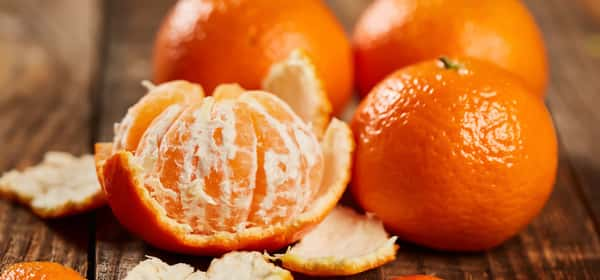
If you peel an orange and notice the spongy white layer under the skin, you’re looking at one of the richest sources of hesperidin — a citrus flavonoid that’s quietly become a staple of vein and circulation supplements. Hesperidin is the compound most often paired with diosmin in the formulas prescribed across Europe for heavy legs and varicose veins. Here’s what it does, how it’s dosed, where to find it in food, and how solid the science actually is.
Quick answer
- What it is: a flavanone (a type of flavonoid) concentrated in citrus fruit, especially the peel and pith
- Main use: vein and circulatory support — heavy legs, mild swelling, varicose vein and hemorrhoid symptoms
- Famous combo: diosmin + hesperidin (micronized purified flavonoid fraction, MPFF) for venous insufficiency
- Typical dose: around 500 mg/day on its own; the diosmin/hesperidin combo is commonly 1,000 mg/day (900 mg diosmin + 100 mg hesperidin)
- Food sources: oranges, lemons, grapefruit, and the white pith in particular
- Evidence: decent for venous symptoms; promising but preliminary for blood pressure, metabolism, and bone
- Generally safe and well tolerated
What hesperidin is
Hesperidin is a flavanone, a subclass of flavonoids, and it’s one of the dominant flavonoids in citrus fruit. In the body it’s broken down to its active form, hesperetin. Like its flavonoid cousins, it brings antioxidant and anti-inflammatory activity, but its real claim to fame is what it seems to do for blood vessels.
A review of citrus flavonoids describes hesperidin and hesperetin as having anti-inflammatory and antioxidant effects, with research spanning vascular health, metabolism, and even bone — where they reduced markers of bone breakdown and supported bone-building cells in lab and animal studies.1 As with most flavonoids, the mechanistic story is rich; the human clinical story is more selective.
Real meals matter more than any supplement. Choose your goal and get your plan.
Powered by DietGenie Eat healthy
 Lose weight
 Gain muscles
 Explore new cuisines
Hesperidin belongs to the same broad family covered in our quercetin pillar guide, but it has carved out its own role around the venous and circulatory system.
Why hesperidin is used for veins and circulation
The core idea is the same as with rutin: flavonoids like hesperidin appear to strengthen capillary and vein walls, reduce how much fluid leaks into surrounding tissue, and calm the inflammation that goes along with sluggish venous return. That’s why it’s a fixture in products aimed at chronic venous insufficiency — the condition behind heavy, aching, swollen legs and varicose veins.
Hesperidin almost never works alone in these formulas. It’s paired with diosmin as the micronized purified flavonoid fraction (MPFF), one of the best-studied venoactive treatments. A 2025 systematic review of venoactive compounds found this class — which includes diosmin/hesperidin — had at least moderate-quality evidence for improving venous symptoms, reducing swelling, and helping venous ulcers heal, and noted diosmin showed promise as an add-on for preventing post-thrombotic syndrome.2 A separate 2025 meta-analysis on chronic venous insufficiency used diosmin and hesperidin as the standard reference therapy that newer agents were compared against — a sign of how established the combo is.3
If you want to compare the two main vein-support flavonoids side by side, see our guide to rutin, the other classic venoactive flavonoid.
The diosmin + hesperidin combo
This pairing deserves its own note because it’s so dominant in the venous space.
| Form | Typical makeup | Used for |
|---|---|---|
| MPFF (micronized) | ~900 mg diosmin + 100 mg hesperidin per 1,000 mg dose | Chronic venous insufficiency, hemorrhoids |
| Hesperidin alone | ~500 mg/day | General circulatory and antioxidant support |
| Diosmin alone | 600 mg/day common | Venous symptoms |
The “micronized” part matters: grinding the flavonoids into very fine particles improves absorption, which is one of the reasons MPFF has more clinical backing than generic flavonoid blends. If a product just says “bioflavonoid complex,” you don’t really know what you’re getting — the standardized diosmin/hesperidin ratio is what the studies used.
Suggested read: Compression Boots: Do Recovery Boots Actually Work?
Beyond veins: the more preliminary stuff
Hesperidin gets researched for plenty beyond circulation, but the evidence thins out:
- Blood pressure and metabolism: a systematic review of dietary polyphenols in metabolic syndrome noted that citrus products and hesperidin improved lipid metabolism, and that hesperidin was among the compounds linked to better endothelial (blood vessel lining) function in some trials.4 Worth knowing, not yet a reason to take it specifically for blood pressure. For lifestyle approaches there, see ways to lower blood pressure.
- Bone health: lab and animal work suggests citrus flavanones including hesperidin may support bone density and reduce bone breakdown, but this hasn’t been confirmed in solid human trials.1
- Inflammation and antioxidant support: plausible and consistent in mechanism studies, but hard to pin to specific everyday benefits.
The honest line: outside of venous support, hesperidin’s benefits are promising but preliminary. Don’t take it expecting it to lower your blood pressure or build your bones.
Food sources of hesperidin
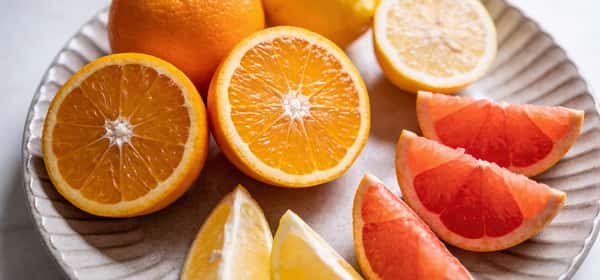
This is a flavonoid you genuinely get from a normal diet, especially if you eat whole citrus rather than just drinking strained juice. The richest part is the white pith and membranes — the bits people tend to pick off.
| Food | Notes |
|---|---|
| Oranges (with pith) | One of the top sources; the white layer is loaded |
| Lemons and limes | Strong contributors, peel and pith especially |
| Grapefruit | Good source of citrus flavanones |
| Tangerines and mandarins | Reliable everyday source |
| Orange and citrus juice (pulpy) | Some hesperidin, less than the whole fruit |
Eating the segments with their membranes intact, rather than peeling everything down to the flesh, gets you noticeably more. For more on these fruits, see health benefits of grapefruit and health benefits of lemons.
How to use it and safety
If you’re considering a supplement:
- General support: about 500 mg hesperidin per day is a common dose
- Venous symptoms: the micronized diosmin/hesperidin combo at 1,000 mg/day is the better-studied choice — follow the product or your clinician
- Give it time: any vascular benefit builds over weeks of consistent use, and it pairs well with the basics — compression, movement, and leg elevation for venous symptoms
On safety, hesperidin is generally well tolerated, with food intake being a non-issue and supplements rarely causing more than mild digestive upset. Still:
- Grapefruit caution: grapefruit itself interacts with many medications via a different mechanism (not hesperidin specifically), so if you take prescription drugs and use citrus-derived supplements, check with your pharmacist.
- Blood thinners: flavonoids can have mild effects on clotting — mention it if you’re on anticoagulants.
- Pregnancy and breastfeeding: not enough safety data on supplement doses; stick to food.
If you have significant varicose veins, persistent swelling, or signs of a clot, see a doctor rather than relying on a supplement.
Suggested read: 14 Foods That Increase Blood Flow & Circulation
Bottom line
Hesperidin is the citrus flavonoid behind a big chunk of the vein-support market, and for good reason — paired with diosmin as micronized MPFF, it’s one of the better-evidenced venoactive treatments for heavy, swollen legs and chronic venous insufficiency. On its own, around 500 mg a day is typical; the standardized 1,000 mg diosmin/hesperidin combo is the choice with real clinical backing. Beyond veins, its links to blood pressure, metabolism, and bone are interesting but still preliminary, so keep expectations grounded. The nice part is you get meaningful amounts from whole citrus, especially the pith most people throw away. For the wider flavonoid story, see the quercetin pillar; for the related compounds, rutin and bromelain.
Ortiz AC, Fideles SOM, Reis CHB, et al. Therapeutic Effects of Citrus Flavonoids Neohesperidin, Hesperidin and Its Aglycone, Hesperetin on Bone Health. Biomolecules. 2022;12(5):626. PubMed | DOI ↩︎ ↩︎
Gloviczki ML, Stoughton J, Puggioni A, Gloviczki P, Raffetto JD. Utility of venoactive compounds in post-thrombotic syndrome: A systematic review. J Vasc Surg Venous Lymphat Disord. 2025;13(4):102228. PubMed | DOI ↩︎
Miguel CB, Andrade RS, Mazurek L, et al. Emerging Pharmacological Interventions for Chronic Venous Insufficiency: A Comprehensive Systematic Review and Meta-Analysis of Efficacy, Safety, and Therapeutic Advances. Pharmaceutics. 2025;17(1):59. PubMed | DOI ↩︎
Amiot MJ, Riva C, Vinet A. Effects of dietary polyphenols on metabolic syndrome features in humans: a systematic review. Obes Rev. 2016;17(7):573-586. PubMed | DOI ↩︎