Walk into any supplement store and you’ll see creatine in a dozen forms — monohydrate, HCl, ethyl ester, buffered, micronized, liquid, magnesium chelate. The marketing claims are loud: “better absorption,” “no water retention,” “no loading phase needed,” “more bioavailable.” The actual evidence? Creatine monohydrate remains the most-studied, most-effective, and cheapest form for nearly every person. The newer forms cost 3–10x more for benefits that either don’t exist or are marginal at best.
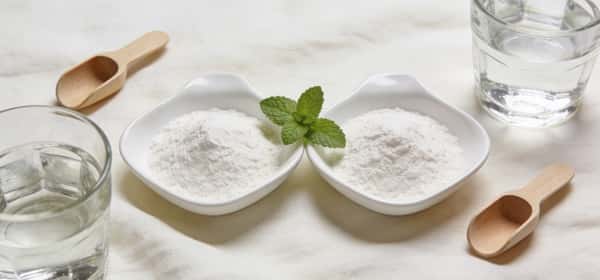
This guide cuts through the marketing, explains what each form actually is, and gives you a clear answer on which to buy.
Quick answer
- Recommended form for nearly everyone: Creatine monohydrate (specifically Creapure-branded for guaranteed purity)
- Cost difference: Monohydrate is typically 3–5x cheaper per effective dose
- Evidence base: Monohydrate has hundreds of RCTs; HCl has a small fraction of that, with no clear superiority demonstrated
- When HCl might make sense: Persistent GI issues with monohydrate despite reasonable troubleshooting
- What doesn’t matter: Liquid forms, ethyl ester, buffered creatine (“Kre-Alkalyn”), most “premium” forms
What each form actually is
Creatine monohydrate
The original form: creatine bound to one water molecule. About 88% creatine by weight. Studied since the 1990s in hundreds of trials. Cheap to manufacture, stable, and well-absorbed.
Real meals matter more than any supplement. Choose your goal and get your plan.
Powered by DietGenie Eat healthy
 Lose weight
 Gain muscles
 Explore new cuisines
Creatine HCl (hydrochloride)
Creatine attached to a hydrochloric acid molecule. About 78% creatine by weight (so the same 1 g of “creatine HCl” delivers slightly less actual creatine than monohydrate). Marketed as more water-soluble and absorbed at lower doses.
Other forms (briefly)
- Creatine ethyl ester — marketed as better absorbed; actually degrades to creatinine (a metabolite, not active creatine) in the stomach
- Buffered creatine (Kre-Alkalyn) — uses alkaline buffering to “prevent breakdown” in stomach; no real-world advantage shown
- Liquid creatine — degrades in solution within weeks; less stable than powder
- Creatine magnesium chelate — bound to magnesium; no clear benefit over monohydrate + separate magnesium
- Micronized creatine — just smaller particle size monohydrate; mixes better but same effect
For the broader picture: creatine monohydrate covers the main form in depth, and creatine the overall context.
The HCl claims, evaluated
Creatine HCl marketing typically makes four claims. Let’s go through each.
Claim 1: “Better absorbed”
The pitch: HCl is more water-soluble than monohydrate, leading to faster and more complete absorption.
The reality: Monohydrate is already absorbed at near-100% efficiency at standard 5 g doses. The “absorption advantage” of HCl is mostly marketing — when monohydrate absorbs ~100%, there’s no room for HCl to be “better absorbed.”
What’s actually true: HCl is more water-soluble at high concentrations, which means it mixes more easily and might reduce GI distress in some people. But that’s a tolerance benefit, not an absorption one.
Claim 2: “Lower doses needed”
The pitch: because HCl is “more bioavailable,” you only need 1–2 g instead of 5 g.
The reality: This claim mostly comes from the manufacturer’s own studies. Independent research hasn’t shown that lower HCl doses produce equivalent muscle saturation to standard monohydrate doses. Most users who take “1.5 g HCl” are simply under-dosing and getting less effect — which is sometimes confused for “I don’t need as much.”
Claim 3: “No water retention”
The pitch: HCl doesn’t cause the intramuscular water increase that monohydrate does.
The reality: The water retention is part of how creatine works. Intramuscular water supports protein synthesis and provides the saturated phosphocreatine pool. If HCl genuinely didn’t cause water uptake, it would also be less effective — which independent research hasn’t shown.
What’s more likely: the slight reduction in water weight some HCl users report comes from taking smaller doses, not from a fundamentally different mechanism.
Suggested read: Liposomal Vitamin C: Real Benefits or Just Marketing?
Claim 4: “No loading phase needed”
The pitch: HCl doesn’t require a loading phase.
The reality: Loading phases aren’t necessary for monohydrate either. Daily 5 g monohydrate reaches muscle saturation in 3–4 weeks. The loading phase (20 g/day for 5–7 days) just gets you to saturation faster. See creatine loading phase for the full picture. This isn’t a real HCl advantage.
Cost comparison
A typical price comparison (varies by retailer):
| Form | Cost per gram of creatine | Cost per 5 g effective dose | Monthly cost |
|---|---|---|---|
| Monohydrate (bulk powder, generic) | ~$0.04 | ~$0.20 | $6 |
| Monohydrate (Creapure brand) | ~$0.08 | ~$0.40 | $12 |
| Creatine HCl | ~$0.20–0.40 | ~$1.00–2.00 | $30–60 |
| Liquid creatine | ~$0.30 | ~$1.50 | $45 |
| “Premium” buffered | ~$0.25 | ~$1.25 | $37 |
For most people, monohydrate is roughly 5–10x cheaper than HCl for equivalent or better effect. Over a year of consistent use, that’s $250+ in savings.
When HCl might make sense
There’s one realistic scenario where HCl is worth considering: persistent GI side effects from monohydrate despite reasonable troubleshooting.
Troubleshooting monohydrate GI issues first:
- Take with food (especially carbohydrates)
- Take after a meal rather than fasted
- Split into 2–3 doses across the day
- Use micronized monohydrate (better mixing, smaller particles)
- Reduce dose temporarily and re-titrate
- Take with adequate water (don’t take dry powder)
If you’ve genuinely tried these and still have persistent stomach upset or bloating from monohydrate, HCl is a reasonable next step. The higher solubility may reduce gastric irritation for sensitive users.
For the GI question specifically: does creatine cause bloating — bloating from monohydrate is uncommon at standard doses.
Suggested read: Magnesium Complex: Benefits, What's In It, and How to Choose
What about absorption rate?
A practical reality: creatine is meant to saturate muscle stores over weeks, not provide an acute effect. Whether absorption is 90% or 100% of a single dose matters far less than consistent daily intake over time. The body excretes excess; what you need is enough total intake to reach and maintain saturation, which both forms accomplish at standard doses.
The “purity” question
Most concerns about creatine quality apply to all forms — not just monohydrate vs. HCl. The relevant quality factors:
- Manufacturing source — German-made (Creapure-branded) creatine has the highest purity standards
- Third-party testing — look for NSF Certified for Sport or Informed Sport labels
- Avoid imported “creatine” from unknown sources — particularly cheap bulk powder from gray-market sources
A reputable monohydrate (Creapure or NSF-tested) is just as pure as any “premium” HCl product, often more so.
Other “premium” forms reviewed quickly
Creatine ethyl ester (CEE)
Skip it. Research shows CEE degrades rapidly to creatinine (an inactive metabolite) in stomach acid. You’re essentially paying for less actual creatine.
Buffered creatine / Kre-Alkalyn
Skip it. The buffering claim — that monohydrate breaks down in stomach acid — is overstated. Monohydrate is highly stable in the stomach. Studies have not shown Kre-Alkalyn superior to monohydrate.
Liquid creatine
Skip it. Creatine degrades in solution over weeks. By the time a liquid product is sold, mixed at the factory, shipped, sat on shelves, and arrived at your home, much of the creatine has degraded to creatinine.
Creatine magnesium chelate
Probably skip it. No compelling evidence over monohydrate + separate magnesium. Magnesium is cheap; you can take it separately.
Micronized monohydrate
Fine, marginal benefit. Just smaller particle size monohydrate — mixes better in water, similar effectiveness. Slight premium for convenience.
What about “non-responders”?
Some research suggests roughly 20–30% of people don’t show typical performance improvements with creatine — so-called “non-responders.” These people often have:
- Higher baseline muscle creatine (already near saturation from diet)
- Different muscle fiber type distribution
- Lower percentage of fast-twitch fibers (where creatine matters most)
Switching to HCl doesn’t fix this. If you’re a non-responder to monohydrate, you’re likely also a non-responder to HCl — the mechanism is the same. The marketing implication that HCl works for non-responders isn’t well-supported.
Suggested read: NAD Supplements: NMN vs NR and How to Choose
Practical recommendation
For 95% of people:
- Buy creatine monohydrate — Creapure brand if you want guaranteed purity
- Take 5 g daily — any time, with or without food
- Use it consistently for 4+ weeks before evaluating effect
- Skip the loading phase unless you want to saturate faster
If you have GI issues despite troubleshooting:
- Try micronized monohydrate with food
- If still problematic, then HCl is reasonable to try
- Don’t pay premium prices as a first move
For specific populations
Women
Stick with monohydrate. The research base for women specifically is in monohydrate. See creatine for women.
Older adults
Stick with monohydrate. The aging muscle and bone evidence is all monohydrate-based. See creatine for older adults.
Cognitive use
Stick with monohydrate. All cognitive trials have used monohydrate. See creatine and cognition.
Athletes
Stick with monohydrate. Hundreds of performance trials; established protocols.
The honest summary
The supplement industry has good reasons to sell expensive creatine forms — better margins. The actual science overwhelmingly supports monohydrate as the right choice. Reading marketing claims about “better absorption” and “no water retention” should make you skeptical, not impressed.
The exception is genuine GI intolerance to monohydrate despite reasonable troubleshooting. For that small subset, HCl is a reasonable second choice. For everyone else, monohydrate is the answer.
For broader context: creatine, creatine monohydrate, health benefits of creatine, creatine pros and cons. For dosing timing: best time to take creatine and creatine loading phase.
Bottom line
Creatine monohydrate is the right form for nearly everyone — most studied, most effective, and 5–10x cheaper than creatine HCl. The marketing claims about HCl (“better absorption,” “no water retention,” “lower doses needed”) are mostly overstated or directly contradicted by independent research. Monohydrate’s “water retention” is part of how the supplement works, not a side effect. The only realistic case for HCl is persistent GI intolerance to monohydrate despite trying it with food, splitting doses, and using micronized versions. Save your money: buy Creapure-grade monohydrate at 5 g/day and you’ve got the gold standard.