Bromelain is the reason a fresh pineapple can make your tongue tingle — it’s a mix of protein-digesting enzymes packed into the fruit and, even more so, the stem. Beyond the kitchen, bromelain has a long history as a supplement for inflammation, swelling, and stuffy sinuses, and it’s the enzyme you’ll often find tucked into quercetin allergy formulas. Here’s what it actually does, why its dosing units look so strange, and how good the evidence really is.
Quick answer
- What it is: a group of proteolytic (protein-digesting) enzymes from pineapple (Ananas comosus)
- Main uses: reducing inflammation and swelling, easing sinus congestion, supporting recovery after injury or surgery
- Dosing: measured in enzyme activity units — GDU or MCU — not just milligrams (roughly 1 GDU ≈ 1.5 MCU)
- Typical range: about 200–2,000 MCU/GDU per day, often split into doses
- Best taken: between meals for systemic anti-inflammatory effects; with meals if you want it as a digestive aid
- Evidence: decent for acute sinusitis as an add-on; promising but preliminary for most other claims
- Generally well tolerated; main cautions are blood thinners and pineapple/latex allergy
What bromelain is and how it works
Bromelain isn’t a single molecule — it’s a cocktail of enzymes, mainly proteases that break peptide bonds in proteins, plus some other compounds. That protein-chewing activity is the same thing that tenderizes meat in a marinade and what makes it useful in the body.
According to a 2024 review in Nutrients, bromelain shows anti-inflammatory, antioxidant, and immune-modulating activity, and it’s been studied across everything from wound healing and digestion to cardiovascular and respiratory conditions.1 A separate 2023 review in Food & Function lays out the mechanisms in more detail: bromelain appears to dial down inflammatory signaling, can reduce certain inflammatory mediators, and has been investigated for osteoarthritis, rheumatoid arthritis, and asthma.2
Real meals matter more than any supplement. Choose your goal and get your plan.
Powered by DietGenie Eat healthy
 Lose weight
 Gain muscles
 Explore new cuisines
The interesting wrinkle for an oral enzyme is that it actually gets absorbed. One study in people with chronic rhinosinusitis showed that after taking bromelain, the enzyme could be detected in both the bloodstream and the sinus mucosa — evidence it travels from the gut to the tissue where you’d want it to act.3
What the evidence supports
Let’s separate the well-studied from the hopeful.
Sinusitis and sinus congestion
This is bromelain’s strongest claim. A systematic review of herbal medicines for rhinosinusitis found that across multiple randomized trials, bromelain as an add-on treatment significantly improved some symptoms of acute rhinosinusitis, with a meta-analysis of two trials supporting that benefit.4 It’s used in parts of Europe specifically as an adjunct for sinus inflammation. The evidence for chronic sinusitis is weaker, but the acute picture is genuinely encouraging.
If allergies are driving your sinus misery, it’s worth reading how the pineapple enzyme pairs with the flavonoid in quercetin for allergies.
Inflammation, swelling, and recovery
Bromelain is widely used for swelling and bruising after injury, dental work, or surgery, and for joint discomfort. The reviews describe consistent anti-inflammatory effects and some clinical signals for osteoarthritis, but the human trials are smaller and more mixed than the sinus data.12 Treat this as plausible and promising rather than nailed down.
Digestion
Because it digests protein, bromelain is sometimes used as a digestive enzyme, especially for people who feel heavy after protein-rich meals. The mechanism is straightforward; the formal evidence is modest.
Suggested read: Phosphatidylserine: Memory, Cortisol, and Dosing
The honest summary
A lot of bromelain’s reputation rests on lab studies, animal work, and small trials. The anti-inflammatory mechanism is real and the sinus evidence is solid for an herbal supplement, but most other uses sit at “preliminary.” Don’t expect it to replace anti-inflammatory medication for a serious condition.
Understanding GDU and MCU dosing
Here’s the part that confuses everyone. Bromelain isn’t dosed purely by weight, because what matters is enzyme activity, not just how many milligrams are in the capsule. Two products with the same milligram count can have very different strength.
So labels use activity units:
| Unit | Full name | Notes |
|---|---|---|
| GDU | Gelatin Digesting Units | The more common, more standardized measure |
| MCU | Milk Clotting Units | Older unit; roughly 1 GDU ≈ 1.5 MCU |
| FIP | Federation Internationale Pharmaceutique units | Seen on some European products |
A practical conversion: a product listed as “500 mg, 2,000 GDU/g” gives you about 1,000 GDU per 500 mg capsule. Always check the GDU or MCU figure, not just the milligram number — that’s the actual strength.
Typical dosing:
- General anti-inflammatory / sinus use: roughly 500–2,000 GDU (about 750–3,000 MCU) per day, often split into two or three doses
- Take between meals for systemic effects — if you take it with food, the enzymes get busy digesting your meal instead of reaching the bloodstream intact
- For digestion specifically, take it with the meal
- Lower end first: start modest and only build up if you tolerate it well
Food vs supplement
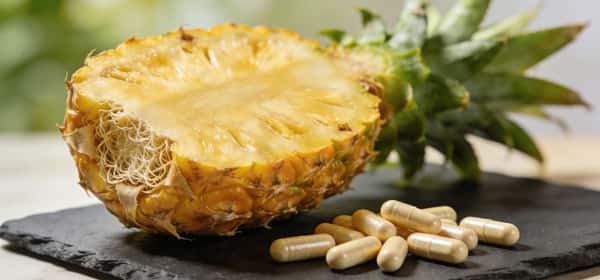
Can you just eat pineapple? Sort of. Fresh pineapple — especially the core — contains bromelain and is a perfectly good reason to enjoy the fruit. But the amount you get from eating it is far below a supplement dose, and most of it is geared toward digestion in the gut rather than systemic anti-inflammatory action. Canned and heavily processed pineapple loses much of the active enzyme to heat.
So for everyday wellness, fresh pineapple is great. For a targeted anti-inflammatory or sinus effect, you’re looking at a standardized supplement. For more on the fruit itself, see pineapple benefits for skin and the health benefits of pineapple.
Suggested read: 8 Science-Based Health Benefits of Pineapple Juice
Safety and who should be careful
Bromelain is generally well tolerated. Side effects, when they happen, are usually mild — stomach upset, diarrhea, or nausea. Still, a few cautions are worth taking seriously:
- Blood thinners: bromelain may have a mild blood-thinning effect, so it can add to the action of anticoagulants and antiplatelet drugs. Talk to your doctor if you’re on them, and stop it before surgery.
- Antibiotics: bromelain can increase blood levels of some antibiotics (like amoxicillin and tetracyclines) — sometimes used deliberately, but worth knowing.
- Pineapple or latex allergy: if you react to pineapple or have latex-fruit syndrome, skip it.
- Pregnancy and breastfeeding: not enough safety data — best avoided as a supplement.
As always, run a new supplement past your doctor or pharmacist if you take prescription medication or have a health condition.
Bottom line
Bromelain is a genuinely interesting pineapple-derived enzyme with a real anti-inflammatory mechanism and the unusual property of being absorbed intact enough to reach inflamed tissue. Its best-supported use is as an add-on for acute sinusitis, where randomized trials back it up; for inflammation, swelling, recovery, and joint comfort the evidence is promising but still preliminary. Dose it by enzyme activity (GDU or MCU), not just milligrams — somewhere around 500–2,000 GDU a day, taken between meals for systemic effects. It’s well tolerated for most people, with the main cautions being blood thinners and pineapple or latex allergy. Eat the fresh fruit for everyday benefit and reach for a standardized supplement when you want a targeted effect. For the broader flavonoid family it’s often paired with, see the quercetin pillar, plus rutin and hesperidin.
Kansakar U, Trimarco V, Manzi MV, Cervi E, Mone P, Santulli G. Exploring the Therapeutic Potential of Bromelain: Applications, Benefits, and Mechanisms. Nutrients. 2024;16(13):2060. PubMed | DOI ↩︎ ↩︎
Kumar V, Mangla B, Javed S, et al. Bromelain: a review of its mechanisms, pharmacological effects and potential applications. Food Funct. 2023;14(18):8101-8128. PubMed | DOI ↩︎ ↩︎
Passali D, Passali GC, Bellussi LM, et al. Bromelain’s penetration into the blood and sinonasal mucosa in patients with chronic rhinosinusitis. Acta Otorhinolaryngol Ital. 2018;38(3):225-228. PubMed | DOI ↩︎
Guo R, Canter PH, Ernst E. Herbal medicines for the treatment of rhinosinusitis: a systematic review. Otolaryngol Head Neck Surg. 2006;135(4):496-506. PubMed | DOI ↩︎