If you’ve gone down the natural-skincare rabbit hole, you’ve hit the two heavyweights of the rich-balm world: beef tallow and shea butter. Both are thick, nourishing, minimally processed moisturizers with devoted fans, and both get recommended for dry skin. But they come from completely different places — one animal, one plant — and they don’t suit the same skin equally. Here’s a clear, honest comparison to help you pick.
Quick answer: Beef tallow is rendered animal fat, rich and occlusive, high in oleic and saturated fatty acids. Shea butter is a plant fat from the African shea tree, also rich but with a different fatty acid mix and naturally high in soothing, anti-inflammatory compounds. Both are excellent for dry, non-acne-prone skin. The main practical differences: shea butter is vegan and generally considered gentler and lower-risk for acne-prone skin, while tallow appeals to those seeking an animal-based, “ancestral” product. Neither has strong clinical trials for facial skincare; both work mainly as emollients that seal in moisture. For the broader picture, see beef tallow for skin.
What each one is
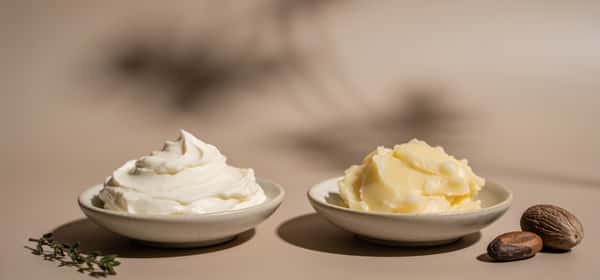
Beef tallow is rendered and purified beef fat (usually suet), solid at room temperature, used as a skin balm for centuries. Its appeal is its simplicity and its “ancestral skincare” story — a single animal-derived ingredient with nothing synthetic.
Glow starts with what you eat. Choose your goal and get your plan.
Powered by DietGenie Eat healthy
 Lose weight
 Gain muscles
 Explore new cuisines
Shea butter is the fat extracted from the nuts of the African shea tree (Vitellaria paradoxa). It’s been used in West African skincare for generations, and unrefined shea is an ivory-colored, slightly nutty-smelling butter. It’s a plant fat, which makes it the go-to rich balm for anyone avoiding animal products.
Both are, at heart, emollient occlusives — fats that soften skin and seal in moisture, which is the same core mechanism behind most moisturizers.1
Fatty acid profiles: the real difference
What separates them on the skin comes down to their fats:
- Beef tallow is dominated by oleic acid (monounsaturated) plus saturated fats (stearic, palmitic). It’s rich and heavy, and that high oleic content is a double-edged sword — luxurious on dry skin, but oleic acid can disrupt the skin barrier and may be problematic for some.2
- Shea butter contains oleic and stearic acids too, but in a different balance, and it’s especially prized for its unsaponifiable fraction — a high proportion of non-fat compounds (including vitamin E and other antioxidants) credited with soothing, anti-inflammatory effects.
In practice, both are rich, but shea’s makeup tends to make it feel a touch lighter and is often better tolerated by sensitive and breakout-prone skin.
Beef tallow vs shea butter at a glance
| Beef tallow | Shea butter | |
|---|---|---|
| Source | Rendered animal (beef) fat | Plant fat (shea tree nuts) |
| Vegan | No | Yes |
| Texture | Rich, heavy, waxy | Rich but creamier, spreadable |
| Key fats | Oleic + saturated (stearic, palmitic) | Oleic, stearic + soothing unsaponifiables |
| Acne-prone skin | Higher risk (heavy, oleic) | Generally gentler, lower risk |
| Vitamins | A, D, E, K (esp. grass-fed) | Vitamin E, antioxidants |
| Best for | Very dry, non-acne skin; ancestral-skincare fans | Dry and sensitive skin; vegans |
Which suits your skin?
Match the balm to your skin and values:
- Very dry, robust skin: both work well; pick on preference (and ethics).
- Sensitive skin or compromised barrier: shea butter’s soothing profile often makes it the safer first try.
- Acne-prone skin: lean toward shea, which is generally considered lower-risk, and be cautious with tallow — more in beef tallow for acne.
- Vegan or avoiding animal products: shea is the obvious choice.
- Drawn to ancestral, animal-based skincare: tallow is the one you’re after — just patch test.
Both are heavy balms, so for either one, a little goes a long way and they’re best on slightly damp skin to lock in moisture. Application tips for tallow are in how to use beef tallow on your face, and most of the same principles apply to shea.
Scent, shelf life, and everyday practicality
Beyond what they do for your skin, a few day-to-day differences can tip the decision:
- Smell. Unrefined shea butter has a distinct nutty, slightly smoky scent that some people dislike; refined shea is nearly odorless. Tallow should smell clean and neutral or faintly beefy — if it smells strongly of meat or goes sour, it’s poor quality or rancid.
- Shelf life. Both are fats that can eventually oxidize, but shea butter is fairly stable and tends to keep well, while tallow is more prone to going rancid and benefits from cool, sealed storage. Smell is your freshness test for either.
- Texture and spread. Shea is usually creamier and easier to spread; tallow is firmer and waxier, which is why it’s often whipped with a carrier oil.
- Cost and sourcing. Both are inexpensive. Quality shea is widely available; quality tallow means seeking out grass-fed, well-rendered products from a trusted source.
None of these are dealbreakers, but if you want a lower-maintenance, near-odorless balm, refined shea has a slight edge on convenience.
What about other natural options?
Tallow and shea aren’t the only contenders. Coconut oil is another popular occlusive (also fairly comedogenic for some), and castor oil shows up in a lot of natural routines. The honest truth across all of them is similar: they’re rich emollients that help dry skin by sealing in moisture, none has strong facial-skincare trial evidence, and the best choice depends on your skin type and how easily you break out. Whatever you pick, supporting your skin barrier with gentle care matters more than the specific balm.
Suggested read: Beef Tallow for Skin: Benefits, Science, Cautions
The bottom line
Beef tallow and shea butter are both excellent rich, natural moisturizers that work the same fundamental way — sealing in moisture as emollient occlusives. The real differences are source and suitability: tallow is an animal fat with an ancestral-skincare appeal but a heavier, higher-oleic profile that’s riskier for acne-prone and sensitive skin, while shea butter is a vegan plant fat with soothing antioxidants that tends to be gentler and more broadly tolerated.
For dry, hardy skin, you can choose on preference and ethics. For sensitive or breakout-prone skin, shea butter is usually the safer starting point. And remember that neither is backed by strong clinical trials for the face — both are nice natural emollients, not miracle treatments. Pick the one that fits your skin and your values, patch test it, and keep your expectations grounded. And if your first choice doesn’t agree with you, switching to the other is cheap and easy — many people end up keeping both around for different needs and seasons.
Kang SY, Um JY, Chung BY, et al. Moisturizer in Patients with Inflammatory Skin Diseases. Medicina (Kaunas). 2022;58(7):888. PubMed ↩︎
Vaughn AR, Clark AK, Sivamani RK, Shi VY. Natural Oils for Skin-Barrier Repair: Ancient Compounds Now Backed by Modern Science. Am J Clin Dermatol. 2018;19(1):103-117. PubMed ↩︎