If you ranked every food by how much nutrition it packs per bite, beef liver would sit at or near the very top. It’s cheap, people have eaten it for thousands of years, and gram for gram it out-nourishes kale, blueberries, and pretty much every trendy superfood you’ve seen on a smoothie menu. The catch is that beef liver benefits come with a couple of real rules — mostly around vitamin A — so this isn’t a food you want to eat by the plateful every day. Here’s the full picture: what’s in it, what it does for you, how much to eat, and who should be careful.
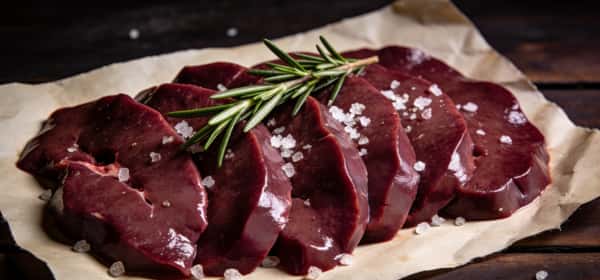
Quick answer: Beef liver is one of the most nutrient-dense foods on the planet. A single 100-gram serving covers your vitamin B12 for weeks, delivers more vitamin A than most people get in a month, and loads you up on copper, riboflavin, folate, choline, and well-absorbed heme iron — all for around 175 calories. Eat about 100 grams once or twice a week and you capture almost all of the upside. The main limit is vitamin A: because liver is so rich in the preformed kind (retinol), daily liver eating can push you into toxic territory, and pregnant women in particular should keep portions small.
What makes beef liver so nutrient-dense
Most “superfoods” earn the label from one or two standout nutrients. Beef liver is different — it’s genuinely loaded across the board, which is why people who study organ meats keep calling liver nature’s multivitamin. Here’s what a 100-gram cooked serving gives you, next to the percentage of your daily value:
Choose your goal and get a meal plan full of foods you actually like.
Powered by DietGenie Eat healthy
 Lose weight
 Gain muscles
 Explore new cuisines
| Nutrient | Amount per 100g | % Daily Value |
|---|---|---|
| Vitamin A (retinol) | ≈6,500 mcg RAE | ≈730% |
| Vitamin B12 | ≈70 mcg | ≈2,900% |
| Copper | ≈14 mg | ≈1,500% |
| Riboflavin (B2) | ≈3.4 mg | ≈260% |
| Folate | ≈260 mcg DFE | ≈65% |
| Choline | ≈330 mg | ≈60% |
| Iron (heme) | ≈6.5 mg | ≈36% |
A few of those numbers deserve a second look. B12 at nearly 3,000% isn’t a typo — the body stores B12 in the liver, so it concentrates there. Copper at 1,500% is a nutrient most people barely think about yet genuinely need for iron metabolism and connective tissue. And that vitamin A figure is where beef liver both shines and demands respect.
Vitamin A: why beef liver benefits your skin, eyes, and immunity
Liver is the single richest common source of preformed vitamin A, or retinol — the ready-to-use form your body doesn’t have to convert. That matters because the beta-carotene in carrots and sweet potatoes has to be turned into retinol first, and plenty of people convert it poorly. Retinol drives night vision, keeps your skin barrier intact, and helps immune cells respond to infection. If you’ve looked at high vitamin A foods, you already know liver tops every list, usually by a wide margin — one serving can cover several days’ worth. For the deeper mechanics of what vitamin A actually does inside the body, that’s its own rabbit hole, but the short version is that liver hands it to you in the most usable form there is.
B12, copper, and the nutrients behind steady energy
This is where liver quietly does its best work. Vitamin B12 keeps your nerves insulated, helps build red blood cells, and sits at the center of turning food into usable energy — and beef liver is one of the densest high vitamin B12 foods you can put on a plate. Riboflavin and folate fill out the B-complex picture; folate supports cell division and matters a lot in early pregnancy, though the form in liver is natural folate rather than synthetic folic acid (a distinction worth knowing — see folate vs folic acid).
Then there’s choline. Liver is one of the richest food sources of it, and most people fall short of the recommended intake.1 Your body uses choline to build cell membranes and the neurotransmitter acetylcholine, and to keep fat moving out of your own liver. Copper, meanwhile, works hand in hand with iron — you need copper to actually use the iron you eat.
Heme iron: liver’s answer to low energy and anemia
The iron in beef liver is heme iron, the type your body absorbs far more efficiently than the non-heme iron in beans, spinach, or fortified cereal. In controlled feeding studies, iron from beef is absorbed substantially better than iron from plant proteins.2 If you run low on iron — common in women of reproductive age, endurance athletes, and anyone eating a mostly plant-based diet — liver is one of the most effective whole foods for topping up. It shows up on every list of high iron foods for exactly this reason. Pair that iron with the copper and B12 already in the same bite, and you’ve got most of the raw material for healthy red blood cells in a single food.
Suggested read: Beef Heart Benefits: Best Starter Organ Meat
How much beef liver to eat (and how to make it taste good)
You don’t need much. About 100 grams once or twice a week is plenty to capture the benefits without overdoing any single nutrient. That’s a small portion — roughly the size of a deck of cards.
Flavor is the usual sticking point. Beef liver has a strong, mineral-y taste that puts people off, but a few tricks tame it:
- Soak the raw liver in milk or a splash of lemon juice for 30 to 60 minutes before cooking. It draws out some of the bitter, metallic edge.
- Pan-fry it fast and hot, about two to three minutes a side. Overcooked liver turns grainy and chalky; a slightly pink center stays tender.
- Blend it into pâté with butter, sautéed onions, and herbs, which mellows the flavor into something rich and spreadable.
- Hide it. Mince a small amount and stir it into ground-beef dishes — burgers, meatballs, chili, bolognese. At roughly a 1:4 ratio you’ll barely notice it’s there.
- If beef liver is still too intense, chicken liver is milder and a gentler place to start.
Not keen on cooking it at all? Desiccated liver supplements are freeze-dried liver in capsule form — a reasonable fallback, though whole cooked liver is cheaper per nutrient.
Is beef liver safe? The honest cautions
For most people, once or twice a week is not just safe but excellent. The cautions are about frequency and a few specific conditions.
Vitamin A is the big one. Because liver is so concentrated in preformed retinol, eating it daily can push you past the safe upper limit, and chronic excess vitamin A causes real harm — headaches, liver damage, bone thinning, and more.3 Intakes only around twice the recommended amount have been linked to higher risk of osteoporosis and hip fracture over the long run.4 That’s why “liver every day” is a bad idea even though liver itself is fantastic.
Pregnancy earns its own line. High doses of preformed vitamin A can harm a developing fetus, so most guidelines tell pregnant women to limit or avoid liver. If you’re pregnant, check with your provider before making liver a regular thing.
Two more groups should take care. If you have gout or high uric acid, keep in mind that organ meats are high in purines, which your body breaks down into uric acid.5 Liver is one of the foods usually flagged on a best diet for gout. And anyone with Wilson’s disease — a rare disorder where copper accumulates in the body — should steer clear of liver because of its heavy copper load.
One reassuring note: eating liver is not bad for your own liver. If anything, its nutrients support the organ. For a wider look at what actually helps, see foods that are good for your liver.
Suggested read: Organ Meats: Benefits, Nutrition & How to Start
The bottom line
Beef liver is close to unbeatable on nutrient density: one small weekly serving covers your B12 many times over, delivers copper, riboflavin, folate, choline, and highly absorbable heme iron, and supplies more usable vitamin A than almost any other food. That last point is also the guardrail — the preformed vitamin A that makes liver so valuable is the same reason you shouldn’t eat it daily, and why pregnant women should be cautious. Treat it as a once-or-twice-a-week powerhouse rather than an everyday staple, soak and cook it right, and you’ve got one of the best nutritional deals in the whole grocery store.
Zeisel SH, da Costa KA. Choline: an essential nutrient for public health. Nutr Rev. 2009;67(11):615-623. PubMed ↩︎
Mayer Labba IC, Hoppe M, Gramatkovski E, et al. Lower non-heme iron absorption in healthy females from single meals with texturized fava bean protein compared to beef and cod protein meals. Nutrients. 2022;14(15):3162. PubMed ↩︎
Hathcock JN, Hattan DG, Jenkins MY, et al. Evaluation of vitamin A toxicity. Am J Clin Nutr. 1990;52(2):183-202. PubMed ↩︎
Penniston KL, Tanumihardjo SA. The acute and chronic toxic effects of vitamin A. Am J Clin Nutr. 2006;83(2):191-201. PubMed ↩︎
Kaneko K, Aoyagi Y, Fukuuchi T, et al. Total purine and purine base content of common foodstuffs for facilitating nutritional therapy for gout and hyperuricemia. Biol Pharm Bull. 2014;37(5):709-721. PubMed ↩︎