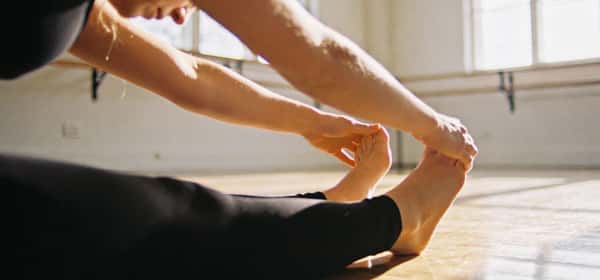
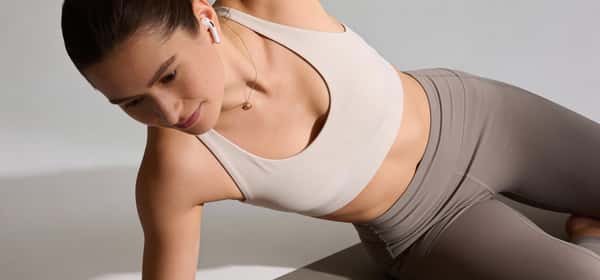
Active stretching uses your own muscles to create the stretch rather than relying on gravity, a partner, or equipment. You contract one muscle group to lengthen the opposing group, holding each position for 10–15 seconds.
This technique forms the foundation of many yoga practices and rehabilitation programs. Unlike passive stretching where external force does the work, active stretching requires you to engage your muscles throughout the movement.
What is Active Stretching?
Active stretching, also called static-active stretching, involves contracting one muscle group to stretch its opposing muscle group. You hold each position using only your muscle strength—no props, bands, or partner needed.
 Lose weight
 Gain muscles
 Eat healthy
 Explore new cuisines
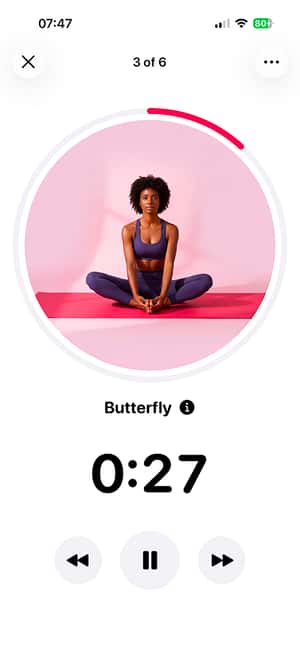
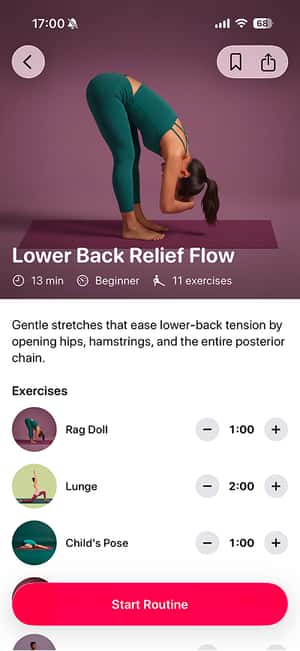
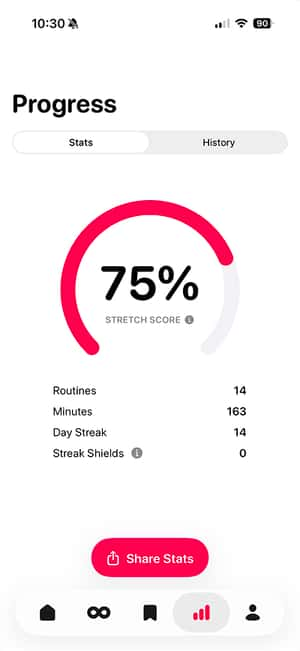
 Emma R.
 Available on the App Store
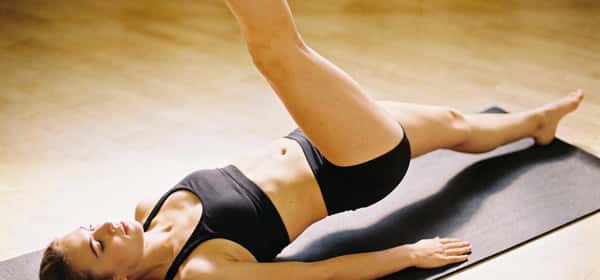
For example, to actively stretch your hamstrings, you lie on your back and lift one leg toward the ceiling. Your hip flexors and quadriceps contract to raise and hold the leg in position, while your hamstrings lengthen. The effort required to maintain the position is what makes it “active.”
The key difference from other stretching methods:
- Static stretching: You hold a position using external force (gravity, a wall, your hands)
- Dynamic stretching: You move through a range of motion repeatedly without holding
- Active stretching: You hold a position using only your muscle contractions
Active stretches typically last 10–15 seconds—shorter than static stretches—because maintaining the position requires continuous muscle effort.1
Benefits of Active Stretching
Improved Range of Motion
Research shows that holding active stretches for 15 seconds produces greater improvements in active range of motion compared to shorter hold times.1 Over time, consistent active stretching increases how far you can move your joints while under your own muscle control.
Better Balance and Stability
Active stretching strengthens the muscles that control movement while lengthening opposing muscles. This combination improves balance, particularly for older adults. A study on women aged 60 and older found that an 8-week active stretching program significantly improved flexibility, muscle torque, and functional mobility.2
Suggested read: Top 10 Health Benefits of Regular Exercise
Increased Blood Flow
Like dynamic stretching, active stretching boosts circulation to working muscles. This delivers oxygen and nutrients while helping clear metabolic waste that accumulates during exercise.
Lower Injury Risk
Because you control the stretch using your own muscles, you can’t force yourself beyond your safe range. Your nervous system acts as a natural limiter—when a muscle can no longer contract to hold the position, the stretch ends. This makes active stretching one of the safest stretching methods.
Muscle Activation and Strength
Active stretching does double duty. While one muscle group lengthens, the opposing group contracts isometrically to hold the position. This builds strength in the contracting muscles while improving flexibility in the stretched muscles.
How to Do Active Stretching
Follow these guidelines for effective active stretching:
- Move into position slowly until you feel a mild stretch in the target muscle
- Contract the opposing muscle to hold the position
- Hold for 10–15 seconds while breathing normally
- Release and rest for a few seconds
- Repeat 2–3 times per muscle group
You don’t need to warm up before active stretching, but your muscles will respond better after light movement like walking. Aim for at least 3 sessions per week, spending 10–15 minutes on targeted areas.
For a structured approach to building a stretching habit, check out this beginner’s guide to stretching.
Active Stretching Exercises
Standing Quad Stretch
- Stand on one leg (hold a wall for balance if needed)
- Bend your opposite knee and bring your heel toward your glutes
- Instead of grabbing your foot, use your hamstrings to pull your heel closer
- Hold for 10–15 seconds
- Switch legs
This actively stretches your quadriceps while strengthening your hamstrings.
Supine Hamstring Stretch
- Lie flat on your back
- Keep one leg straight on the floor
- Raise the other leg toward the ceiling, keeping it straight
- Use your hip flexors and quadriceps to lift and hold your leg
- Hold for 10–15 seconds when you feel a hamstring stretch
- Lower and switch legs
This is one of the most common active stretches and directly targets tight hamstrings—a common problem for people who sit at desks.
Suggested read: 8 Simple Stretches to Relieve Lower Back Pain
Overhead Tricep Stretch
- Raise one arm straight overhead
- Bend your elbow to lower your hand behind your head
- Contract your biceps to deepen the bend and stretch your triceps
- Hold for 10–15 seconds
- Switch arms
Standing Calf Stretch
- Stand with feet hip-width apart
- Shift your weight to one leg
- Lift the toes of your other foot while keeping your heel on the ground
- Contract your shin muscles (tibialis anterior) to pull your toes higher
- Hold for 10–15 seconds
- Switch sides
Hip Flexor Activation
- Stand tall or lie on your back
- Bring one knee toward your chest
- Use your hip flexors to pull your knee higher without using your hands
- Hold for 10–15 seconds at the top
- Lower and switch legs
This stretches your glutes and lower back while strengthening your hip flexors.
Active vs. Passive Stretching
Both methods effectively improve flexibility, but they work differently and suit different purposes.3
| Aspect | Active Stretching | Passive Stretching |
|---|---|---|
| Effort required | High (muscle contraction) | Low (external force) |
| Hold duration | 10–15 seconds | 30–60 seconds |
| Equipment needed | None | Sometimes (straps, blocks) |
| Best timing | Before or during exercise | After exercise |
| Strength benefit | Yes | Minimal |
| Injury risk | Very low | Low to moderate |
Active stretching works well as part of a warm-up because it engages muscles and increases body temperature. Passive stretching fits better in a cool-down routine when muscles are already warm and you want deeper relaxation.
For a deeper comparison of stretching methods, see this breakdown of static vs dynamic stretching.
When to Use Active Stretching
Before workouts: Active stretching prepares your muscles for movement without the performance decrease sometimes seen with long-held static stretches.4
During breaks: Because active stretching requires no equipment, you can do it anywhere—at your desk, during travel, or between sets at the gym.
In rehabilitation: Physical therapists often prescribe active stretching because it builds strength and flexibility simultaneously while remaining low-risk.
For general fitness: Spending 10–15 minutes on active stretching 3–4 times per week maintains good flexibility for daily activities.
Frequently Asked Questions
What is active stretching?
Active stretching uses your own muscle contractions to create and hold a stretched position, without relying on gravity, a partner, or equipment. You contract one muscle group to lengthen the opposing group, holding each position for 10-15 seconds.
This technique forms the basis of many yoga poses and rehabilitation exercises, making it one of the most practical stretching methods.
What is the difference between active and passive stretching?
Active stretching uses your own muscles to hold the stretch position, while passive stretching relies on external forces like gravity, a strap, or a partner. Active stretches are shorter (10-15 seconds) and build strength, while passive stretches are longer (30-60 seconds) and focus purely on flexibility.
For a detailed comparison, see this breakdown of static vs dynamic stretching.
Is active stretching better than static stretching?
Neither is universally better—they serve different purposes. Active stretching is ideal before workouts because it warms muscles and builds strength simultaneously. Static stretching works better after exercise for deeper flexibility gains. The best routine includes both.
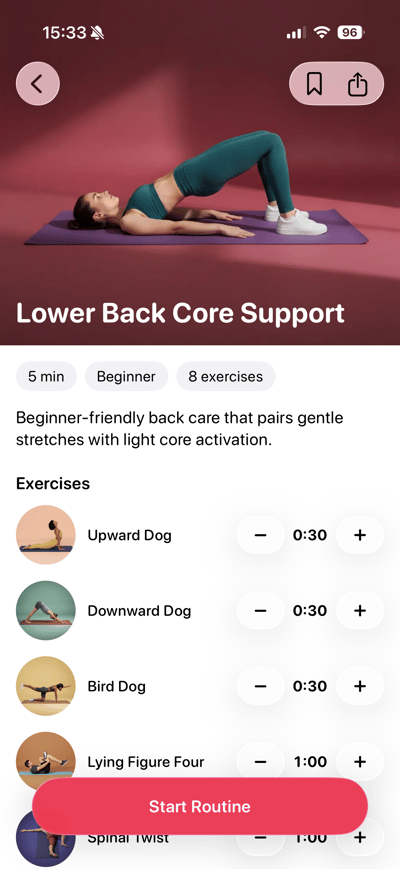
The Stretching Workout app includes both active and static stretching routines so you can use the right technique at the right time.
How long should you hold an active stretch?
Hold active stretches for 10-15 seconds per repetition, completing 2-3 reps per muscle group. Active stretches are held shorter than static stretches because maintaining the position requires continuous muscle effort, which fatigues the muscles faster.
Can beginners do active stretching?
Yes, active stretching is beginner-friendly and one of the safest stretching methods. Because you control the stretch using your own muscles, your nervous system acts as a natural limiter—preventing you from pushing beyond your safe range.
The Stretching Workout app offers guided routines for all levels, including active stretching sessions with voice cues and timers.
The Bottom Line
Active stretching builds flexibility and strength at the same time by using your own muscles to create and hold stretched positions. It’s safe, requires no equipment, and works well before exercise or anytime you want to improve mobility.
Start with the exercises above, holding each for 10–15 seconds. Consistency matters more than intensity—regular practice over weeks will produce noticeable improvements in how you move.
Roberts JM, Wilson K. Effect of stretching duration on active and passive range of motion in the lower extremity. Br J Sports Med. 1999;33(4):259-63. PubMed ↩︎ ↩︎
Batista LH, Vilar AC, de Almeida Ferreira JJ, Rebelatto JR, Salvini TF. Active stretching improves flexibility, joint torque, and functional mobility in older women. Am J Phys Med Rehabil. 2009;88(10):815-22. PubMed ↩︎
Watt JR, Jackson K, Franz JR, Dicharry J, Evans J, Kerrigan DC. Passive versus active stretching of hip flexor muscles in subjects with limited hip extension: a randomized clinical trial. Phys Ther. 2004;84(9):800-7. PubMed ↩︎
Page P. Current concepts in muscle stretching for exercise and rehabilitation. Int J Sports Phys Ther. 2012;7(1):109-19. PubMed ↩︎
 Sarah M.
 Linda P.
 Maya T.
 Marcus J.
 Emma R.
 Amanda K.
 Chris B.
 David L.
 James W.
 Jennifer S.
 Kevin H.
 Lisa C.
 App Store ★★★★★